How to Become an AI Engineer in 2026: Complete Roadmap (₹12-40 LPA)
Not a list of topics — an order. What to learn first, what can wait, what to build at each stage, the real salary bands, and the four mistakes that quietly add months.
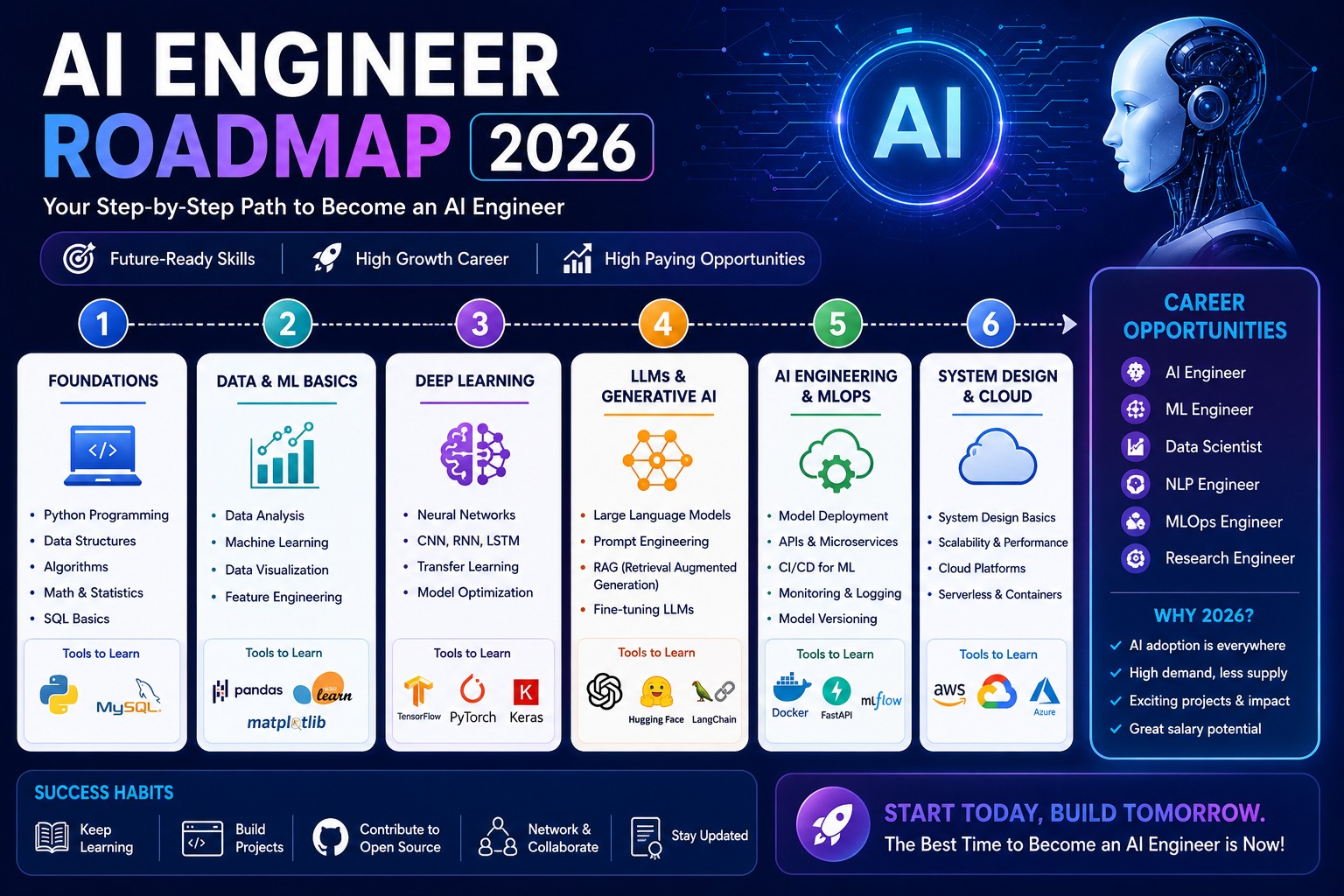
Introduction: The AI Revolution is Here
Remember when everyone said "learn to code"? In 2026, the new mantra is "learn AI." India needs a large and fast-growing pool of AI professionals, but only a fraction of that talent exists today — and that gap is the opportunity.
If you're a software engineer stuck at ₹6 LPA, a fresh graduate struggling to find jobs, or someone looking to switch careers, AI engineering could be your path to ₹15–40 LPA packages. The catch: most people don't know where to start. This guide breaks down exactly how to become an AI Engineer in 2026 — the skills, the timeline, and the pay.
What is an AI Engineer? (And Why Everyone Wants This Job)
An AI Engineer sits at the intersection of software engineering and machine learning. Unlike a pure Data Scientist who focuses on analysis, an AI Engineer builds and deploys intelligent systems that run in production — systems that understand language, recognise images, make predictions, and generate content. Day-to-day that means:
- Building machine learning pipelines that process real-world data at scale
- Fine-tuning and deploying Large Language Models (LLMs) for specific business use cases
- Building RAG (Retrieval-Augmented Generation) systems with vector databases like Pinecone or Weaviate
- Integrating AI APIs (OpenAI, Anthropic, Gemini) into production applications
- Monitoring model performance and handling data drift in production
Why This Role is Exploding
- Hundreds of thousands of open AI positions globally, with India among the fastest-growing markets
- Companies paying 2–3x more than regular software roles
- Even early-stage startups now offer ₹20+ LPA for strong AI talent
ChatGPT changed the baseline overnight. For a deeper look at the highest-paying specialisation, see our guide to the LLM Engineer role (₹40–74 LPA).
AI Engineer Salary in India (2026 Data)
Let's talk money — after all, that's what brought you here. For a full city and role deep-dive, see our AI Engineer salary in India 2026 breakdown.
| Experience Level | Salary Range | Typical Employers |
|---|---|---|
| Fresher / 0-1 year | ₹12-18 LPA | AI startups, TCS, Wipro Digital |
| 1-3 years | ₹18-28 LPA | Infosys AI, Flipkart, Swiggy |
| 3-5 years | ₹28-40 LPA | Zomato, Paytm, PhonePe, CRED |
| 5+ years (Senior/Lead) | ₹40-70+ LPA | Google India, Microsoft, Meesho |
Special High-Paying Roles
LLM Engineer
GenAI Engineer
MLOps Engineer
City-wise Salary Comparison
- Bangalore (highest) — ₹18–45 LPA average
- Hyderabad — ₹15–38 LPA average
- Pune — ₹14–35 LPA average
- Delhi-NCR — ₹13–32 LPA average
- Mumbai — ₹14–40 LPA average
Pro tip: remote work is huge in AI — many engineers in Tier-2 cities earn Bangalore-level salaries. If your goal is the career track specifically, our AI Engineer course maps each phase below to a hiring milestone.
Complete AI Engineer Roadmap (Month-by-Month Plan)
A phase-by-phase plan. Each phase has a clear goal, a realistic time investment, and hands-on projects to lock in the skill. Follow the order — skipping ahead is the single biggest reason people stall.
Months 1–2 · Build programming & math fundamentals · 2–3 hrs/day
Python Programming (4 weeks)
- Syntax, data structures, OOP, file & exception handling
- NumPy, Pandas, Matplotlib
- 50+ problems on LeetCode / HackerRank
Mathematics for AI (4 weeks)
- Linear algebra — matrices, vectors
- Calculus — derivatives, gradients
- Probability & statistics
Outcome: write Python confidently and understand the math AI is built on.
Months 3–4 · Master traditional ML algorithms · 3–4 hrs/day
- Supervised learning: linear & logistic regression, decision trees, random forest, SVM, KNN (scikit-learn)
- Unsupervised learning: K-means clustering, PCA, anomaly detection
- Model evaluation: train-test split, cross-validation, precision/recall/F1, ROC-AUC
Months 5–6 · Build neural networks for complex tasks · 4–5 hrs/day
- Basics: perceptrons, activation functions, backpropagation, gradient descent (TensorFlow/Keras or PyTorch)
- CNNs: image classification, object detection (YOLO), transfer learning (ResNet, VGG)
- RNNs: LSTM, GRU, time-series forecasting, text generation
Month 7 · Make machines understand human language · 3–4 hrs/day
- Fundamentals: text preprocessing, tokenization, word embeddings, named entity recognition
- Transformers & LLMs: BERT, GPT architecture, Hugging Face, fine-tuning pre-trained models
Month 8 · Master the most in-demand AI skills of 2026 · 5–6 hrs/day
- Large Language Models: GPT-4, Claude, Gemini, LLaMA — API integration, prompt engineering
- RAG: vector databases (Pinecone, Weaviate), semantic search, LangChain, LlamaIndex
- Fine-tuning: LoRA, PEFT techniques, domain-specific models
Most 2026 AI job postings explicitly call out LLM/GenAI skills — this phase carries outsized weight and pushes you toward the ₹20–40 LPA band.
Month 9 · Deploy models to production · 3–4 hrs/day
- Containerization: Docker basics, Dockerfile for ML models, Docker Compose
- Cloud: AWS (SageMaker, EC2, Lambda), Azure ML, GCP (Vertex AI)
- CI/CD for ML: GitHub Actions, model versioning, monitoring & logging
Month 10 · Get hired · 2–3 hrs/day
- Portfolio: 8–10 projects on GitHub, technical blog posts, Kaggle profile, LinkedIn content
- Resume: ATS-friendly format, quantified achievements, relevant projects with metrics
- Interviews: ML theory + coding, system design for ML, behavioural rounds, company research
Outcome: job offers start coming in.
Common Mistakes to Avoid
How Long Does It Really Take?
Full-time (8–10 hrs/day)
6 months to job-ready · 9 months to senior-level
Part-time (2–3 hrs/day)
12–15 months to job-ready
Already an SWE?
Fast-track: 3–4 months, focus on ML/DL
| Background | Estimated Time to First Job |
|---|---|
| CS/IT graduate with Python basics | 6-9 months |
| Non-CS engineer (Mechanical, Civil, etc.) | 10-14 months |
| Working IT professional switching career | 8-12 months |
| Complete non-tech background | 12-18 months |
Career Paths in AI Engineering
The roadmap opens several tracks. For a full role-by-role map, see our AI career path guide.
- Generalist AI Engineer (₹15–35 LPA) — works across diverse AI projects at product companies and startups.
- LLM Specialist (₹25–74 LPA, highest paid) — builds and fine-tunes LLMs at AI startups and FAANG.
- Computer Vision Engineer (₹18–45 LPA) — image/video AI for autonomous vehicles and healthcare.
- MLOps Engineer (₹20–70 LPA) — deploys and maintains ML systems across all tech companies.
- AI Research Scientist (₹30–80+ LPA) — develops new algorithms at research labs, FAANG and universities.
Want the guided version of this roadmap?
Join Shifttotech's AI course — hands-on training, LLM/GenAI specialization, and placement assistance. Next batch starts September 20, 2026.
Explore the AI Course →Frequently Asked Questions
Q1: Do I need a degree in CS/AI?
Q2: Can I learn AI without math?
Q3: Which is better: TensorFlow or PyTorch?
Q4: Should I do certifications?
Q5: How do I get my first AI job with no experience?
Q6: Is AI engineering saturated?
Q7: Can I switch from a non-tech background?
Action Plan: Start Today
Week 1 Tasks
- Day 1–2: install Python & Jupyter, create a GitHub account, join AI communities
- Day 3–4: Python basics — variables, loops, functions, data structures
- Day 5–7: build a first mini-project — calculator, to-do app, or Pandas data analysis
Free Resources to Start Now
- Learning: Sentdex, Corey Schafer (YouTube), Kaggle courses, Fast.ai, Google Colab
- Communities: r/MachineLearning, AI Discord servers, LinkedIn AI groups, Kaggle discussions
- Practice: LeetCode, Kaggle competitions, GitHub open source
Conclusion: Your AI Career Starts Now
The AI revolution isn't coming — it's already here. You don't need a PhD or to be a genius mathematician. You need consistency (3–4 hours daily), hands-on practice, a clear roadmap (you have it now), and 6–12 months of focused effort.
If you want structured guidance from industry mentors with placement support, our AI course follows exactly this roadmap. Explore it by city: Bangalore, Delhi NCR, Mumbai, Hyderabad, Chennai, Pune, or online →