How to Choose AI/ML Training in Hyderabad (2026): What to Check Before You Pay
 By ShiftToTech Academy
Published
Updated

By Sayeed Amaan, AI Lead at SophyXis Technologies (LinkedIn) · Reviewed by ShifttoTech Academy Team · Updated on 5 November 2026
Type “AI/ML training in Hyderabad” into Google and you’ll get the same page about fifty times. The logo changes. The promises don’t. Python, machine learning, GenAI, and of course “100% placement support”. Ameerpet alone has dozens of these centres, KPHB has a few dozen more, and then there’s every online platform under the sun plus that one cousin who swears his institute changed his life.
So where do you actually put your money?
Nobody can give you one right answer. Wrong answers, though, are easy to find, and they cost a lot. Four or five months of evenings. Somewhere between ₹30,000 and ₹1,50,000. And the worst part is you usually find out late, sitting in an interview, when someone asks you to explain a project and you realise the course never really showed you how.
What follows is basically the checklist I’d hand a friend before they pay anyone. Use it on any institute. Use it on us too. (Already decided and just want our syllabus and dates? They’re on the AI course in Hyderabad: syllabus, fees and batch dates page.)
Quick answer: look at five things. Is there real ML in the syllabus, with LLMs, RAG and MLOps on top? Has the trainer shipped models in an actual job? Is the batch size written down? Can you see what past students built on GitHub? And do the placement stories check out on LinkedIn? If all five hold up, you’re probably fine.
A few things worth remembering
-
Placement assistance and a job guarantee aren’t the same thing, no matter how the ad is worded.
-
Do ML before GenAI. It’ll make GenAI far easier.
-
Get one past student’s GitHub link before you pay a single rupee.
-
Where the institute sits on the map tells you nothing about how good it is.
-
Working full-time? Think 4 to 6 months. Anyone saying 6 weeks is selling something.
What kinds of AI/ML training can you get in Hyderabad?
There are four, more or less. Classroom institutes (Ameerpet, KPHB and Madhapur have most of them), live online batches, self-paced courses, and university programmes like IIIT Hyderabad’s iHub-Data. Which one suits you has less to do with the institute and more to do with you, mainly how you learn and how much feedback you need.
|
Format |
How it works |
Feedback on your work |
Best for |
Watch out for |
|---|---|---|---|---|
|
Classroom institute |
Fixed timings at a centre, usually evenings or weekends |
Depends heavily on batch size |
People who need a routine and classmates around them |
The commute after work, batches of 30 or more, older syllabi |
|
Live online batch |
Same live classes, joined from home |
Good, if the batch is small and someone reviews your code |
Working professionals, anyone far from the IT corridor |
Easy to stay on mute and drift |
|
Self-paced course |
Recorded videos, watch whenever |
Usually none |
Finding out if you like AI at all, or picking up one skill |
Nobody checks your projects or preps you for interviews |
|
University programme |
Longer and structured, often some in-person classes |
Usually strong |
Students who meet the eligibility rules |
Limited eligibility, fixed intake dates |
Classroom training gets a lot of hate online. I think some of it is unfair. Having a fixed slot and a room full of people stuck on the same error at 8 pm is sometimes the only thing that gets you through week three. That said, the costs are real. Work in HITEC City, study in Ameerpet, and you’re spending a good chunk of every class day in evening traffic. At the bigger centres there might be 30 or 40 people in the room too, and no trainer can read that much code.
People tend to forget about the university route. IIIT Hyderabad’s iHub-Data has a six-month AI/ML programme, weekend classes on campus plus online tutorials during the week. It’s aimed at B.Tech students from AICTE-affiliated colleges in and around Hyderabad, so if you’re already working you probably won’t qualify (Telangana Today, July 2026) \[2\]\[3\].
And if you’re honestly not sure you’ll enjoy any of this, hold off on paying. Try Google’s free Machine Learning Crash Course \[4\] for a couple of weeks. Finish it wanting more? Great. Keep finding excuses not to open it? Also useful to know, and it didn’t cost you anything.
Which AI jobs in Hyderabad are you training for?
Sort this out first. Hyderabad isn’t one AI job market, it’s more like five, and each one interviews differently.
|
Employer type |
What interviews usually focus on |
What your training must cover |
|---|---|---|
|
Big tech global capability centres (GCCs) in HITEC City |
Coding, ML fundamentals, system design, a deep dive into one project |
Strong Python, classical ML, deployment, one solid end-to-end project |
|
Banking and financial GCCs in Gachibowli and the Financial District |
Applied ML on tabular data, model evaluation, explaining a model’s predictions |
Regression and classification in depth, feature engineering, SQL |
|
IT services companies on the Cyberabad campuses |
Basics, tools, how well you communicate |
Python, ML basics, some cloud exposure |
|
Pharma and life sciences companies around Genome Valley |
Messy domain data, NLP on research text |
ML plus NLP; your domain background counts for a lot |
|
AI startups in the T-Hub ecosystem |
What you’ve actually shipped |
LLM apps, retrieval-augmented generation (RAG), deployment, a public GitHub |
Look at the last column for the job you’re after and see if the course matches it. A fantastic deep learning course won’t help much if you end up interviewing at a bank where they mostly want simple, explainable models built on customer data. Good course. Wrong room.
What should a good AI/ML course cover in 2026?
The order goes Python and classical ML, then some deep learning, then LLMs, RAG and deployment. Skip the early part and jump to GenAI and you end up with gaps, which interviewers are weirdly good at spotting.
Most syllabi use the same buzzwords, so here’s roughly what “covered” should mean:
|
Skill area |
What “covered” should mean |
|---|---|
|
Python for data |
NumPy, Pandas, and cleaning properly messy data, not tidy textbook CSVs |
|
Classical ML |
Regression, classification, tree models, cross-validation, choosing the right metric |
|
Deep learning |
How neural networks train, CNNs and transformers at a working level, transfer learning |
|
LLMs and prompting |
Calling an LLM API, getting structured output, handling failures and cost |
|
RAG |
Chunking, embeddings, a vector database, and checking whether retrieval actually works |
|
MLOps and deployment |
FastAPI, Docker, a cloud deployment, basic monitoring |
Those bottom two rows are usually where things get thin. Here’s a simple test. By the end of the course, could you build something like this without help?
You take a folder of company policy PDFs and make a little app that answers questions about them. Chunk them, embed them, drop them in a vector database, pull out the right passages. Then you write maybe 30 questions you already know the answers to and see how often the correct passage actually comes back. (Your first score will probably be a bit embarrassing. Everyone’s is.) Fix it, put it behind FastAPI, Docker it, push it to AWS. Then write a README explaining why you picked that chunk size and what broke.
Funny thing is, that README might be the most important bit. In interviews nobody’s impressed that the thing runs. What they want to hear is why you made the choices you made. Our guide on how to become an AI engineer goes into the role in more detail, and the generative AI course page shows how we handle the GenAI side.
What should you check before you pay any institute?
Seven checks. An institute that gets through all of them is very likely a decent bet.
First, the syllabus. Ask for the module list and when it was last updated. In 2026 you’d expect LLMs, RAG and a bit of MLOps alongside classical ML, and if the newest thing on the page is CNNs, it’s been a while.
Second, the trainer. Ask for a name and a LinkedIn profile. Has this person built and shipped models at a job, or only taught? Also, quietly check that whoever runs the demo is the one who’ll teach your batch. That’s not always the case.
Third, batch size. A poster saying “small batches” isn’t a number. Get one in writing. Once a batch crosses about 20, proper code review tends to disappear.
Fourth, projects. Ask for two or three GitHub links from recent students. You’re hoping to see deployed apps with real READMEs, not tutorial notebooks with the variable names swapped.
Fifth, what “placement support” actually means there. Is it resume help? Mock interviews? Real referrals? Ask what they don’t do as well. Then ask for a few names of people placed recently, and go look them up.
Sixth, the fee and refund policy. If you only find out the price on a phone call, there’s a fair chance it’s being adjusted to you. Read the refund terms before you pay.
Seventh, the demo itself. Some demos are slick, rehearsed sales pitches. If you can, ask to sit in on a batch that’s already running.
Save this somewhere and go through it for each institute on your list. Comparing answers side by side takes a lot of the stress out.
What should you ask in a demo class?
If you only ask two things, ask these: “Can I see a recent student’s project and LinkedIn?” and “How many people are in the batch I’d be joining?” Those two answers tell you most of the story. The others below help fill the gaps.
-
“Can you show me something a recent student built, and their LinkedIn?” A good institute pulls one up on the spot. “We’ll send it later” often means they won’t.
-
“How many students are in the batch I’d join?” Ask for an actual number.
-
“Who teaches it, and what have they built at work?” Real systems at real companies, ideally. Not just certificates.
-
“Which weeks cover LLMs and RAG, and what do students build in them?” You’re listening for a named project and how it gets evaluated.
-
“How do you review code?” Line-by-line feedback is great. A weekly doubt-clearing call on its own isn’t the same.
-
“What happens if I miss a class?” Recordings and some catch-up option is pretty standard.
-
“What does placement support cover, and what doesn’t it?” Honest places will tell you the limits without being pushed.
-
“How many people from your last two batches got jobs, and how long did it take them?” A number with a timeframe is worth more than any banner.
-
“What’s the full fee, with anything extra?” One figure, and the payment plan in writing.
-
“What’s the refund policy?” Days and conditions.
If they get evasive on any of these, make a mental note.
What are the red flags in Hyderabad AI training ads?
The big one is a placement percentage that nobody can explain. “95% placement” sounds great until you ask how many students that is, over how long, and what they counted as a placement. Usually the answers get vague pretty fast.
A few others pop up all the time. “100% placement” or “guaranteed job” is one, and no institute gets to decide who a company hires. Walls of Microsoft, Google and Amazon logos labelled “hiring partners” are another; often that just means one ex-student got hired there once. Then there are success stories with no surnames and no links, “today only” discounts that somehow run all month, and fees you can only find out on a call.
Watch the syllabus too. A GenAI-only course with no machine learning will leave you stuck the minute an interviewer asks about basics. A course that’s only classical ML but calls itself “AI” has the opposite problem.
We wrote a longer piece on whether placement guarantees are real or fake. It’s about DevOps courses, but the tricks are identical.
How much do AI engineers earn in Hyderabad?
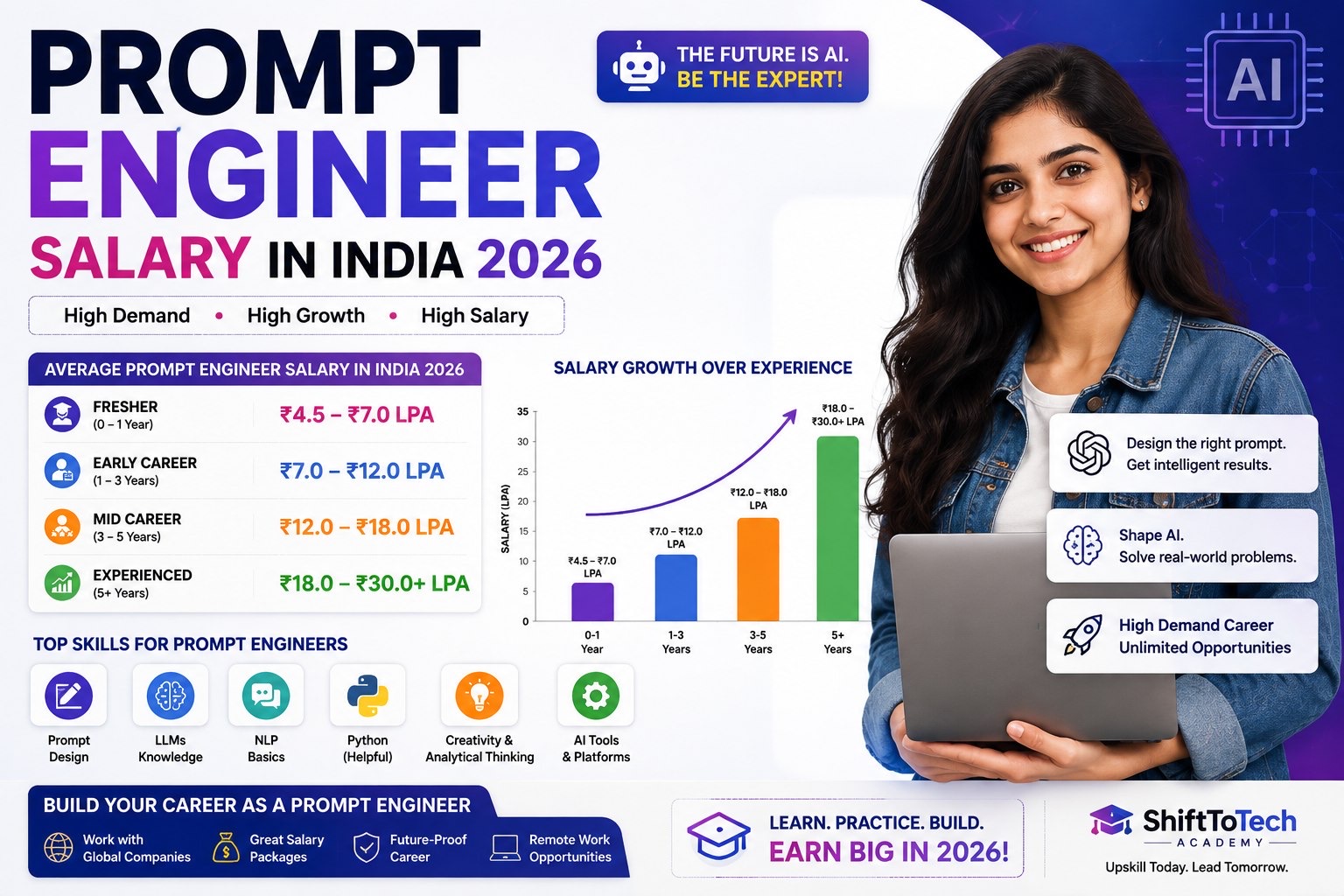
According to AmbitionBox, freshers working as AI engineers in Hyderabad report around ₹4.5 lakh to ₹9.5 lakh a year (their data was last updated in July 2025) \[1\]. Across every experience level, reported salaries go from about ₹3.9 lakh all the way to ₹35 lakh.
That’s a massive range, and it isn’t the course that decides where you land. It’s mostly the company. Same skill set, very different pay at an IT services firm compared to a big tech GCC in HITEC City. So when a course promises a particular package, I’d read that as a warning sign.
For a more detailed breakdown by role and years of experience, see our AI engineer salary in India guide.
How long does it take to become job-ready in AI/ML?
For most people with a full-time job, somewhere around 4 to 6 months. That’s about 3 to 4 months of learning and another 1 to 2 on projects and interview prep, if you can give it 10 to 15 hours a week.
It shifts depending on where you start. Freshers who’ve done some coding can often get there in 4 or 5 months, faster if they have more free hours. Developers tend to be quicker, maybe 3 to 4, since Python and Git are already second nature. If you’re coming from a non-IT background, give yourself 6 to 9 months. The first few weeks of Python are slow for everyone, so don’t panic.
The part people always underestimate is interview prep. After your projects are done, spend a few weeks explaining them out loud to someone (it’s harder than you’d think) and working through common AI/ML interview questions. If a course tells you you’ll be job-ready in a few weeks, something is getting skipped.
What should you prioritise based on your background?
Quick version: freshers need projects, developers need ML depth, analysts need modelling, DevOps people need MLOps. Go for the course that covers your gap, not the one with the glossiest brochure.
Freshers
Projects matter more than anything. Your degree isn’t really what’s holding you back; not having anything deployed is. Look for training that makes you ship two or more projects to GitHub. And write decent READMEs, because recruiters actually click on them.
Developers at IT services companies
You already write code all day, so there’s no point paying for six weeks of Python basics. Look for depth in ML and deployment instead. Your engineering habits are an advantage, and MLOps is where they show up.
Data analysts
SQL, data cleaning, a feel for numbers: you’ve got a head start. What’s missing is usually modelling and evaluation, so pick a course that’s strong on those.
DevOps and cloud engineers
Honestly, MLOps is the shortest way in for you. See how much of the course is really about deploying, monitoring and running models, because that’s where your current skills start counting.
Pharma and life sciences professionals
Domain knowledge is a big plus here, especially around Genome Valley. Spend your time on NLP and messy real-world data rather than flashy GenAI demos.
Non-IT switchers
Testers, support engineers, folks from sales or banking. Very doable. Just make sure the course really does start from zero with Python, and assume it’ll take longer than the brochure says.
Where does ShiftToTech fit?
ShiftToTech teaches AI/ML live online only, in batches of 10, and the fee is published: ₹35,000. Placement support (resume work, mock interviews and referrals) is included. A job guarantee isn’t. If you want to physically sit in a classroom in Hyderabad, ShiftToTech isn’t the right pick for you, and that’s completely okay.
Since batches run nationally, the outcomes ShiftToTech shares come from all over India, not one city. One recent example from the October 2025 AI cohort is Yash Sharma, who joined Sudarshan Herb & Health Care as an AI/ML Engineer Intern and later moved into a Junior AI/ML Engineer role there. His LinkedIn profile is public if you want to check \[5\]. He isn’t a Hyderabad placement, and we’re not going to dress him up as one.
[Original data block: From our [batches A–C], [X] of [Y] learners who were job-hunting got offers within [N] months. Median offer: [₹Z LPA]. Remove this paragraph if the numbers aren’t ready.]
If live online suits you, go ahead and run ShiftToTech through the same seven checks. Syllabus, duration, trainer details and the next batch date are all on the AI course in Hyderabad page.
AI/ML training in Hyderabad: FAQs
How do I choose the right AI training institute in Hyderabad?
Look at five things: whether the syllabus covers ML plus LLMs, RAG and deployment, whether the trainer has deployed models at work, the batch size in writing, real student projects on GitHub, and placement claims you can verify on LinkedIn. Then compare two or three places on exactly those points.
Are Ameerpet AI institutes still worth it in 2026?
Some, yes. Location isn’t what makes an institute good or bad. Check how recently the syllabus changed, who’s teaching, and how big the batches are. A few run batches so large that nobody’s code really gets looked at.
Is online AI training as good as classroom training?
It can be, if the classes are live and the batch is small. You save the commute, which is a big deal if you work in HITEC City. Some people do need a classroom routine though, and that’s fine. Syllabus, trainer and batch size matter more than the format.
Should I learn machine learning before generative AI?
Yes. Interviews in Hyderabad still ask about regression, classification and evaluating models. GenAI also clicks much faster once you understand embeddings and how models behave.
How can I check an institute’s placement claims?
Ask for names of recently placed students and look them up on LinkedIn yourself. Then ask how their placement rate is calculated: how many students, over what period, what counted as a job. Real answers have numbers and dates in them. Vague ones don’t.
Does any AI course in Hyderabad guarantee a job?
No. An institute can help with your resume, mock interviews and referrals, but the hiring decision belongs to the company. Some places offer a written “guarantee” with conditions attached, like attendance or a minimum number of applications. Read those conditions carefully before you count on it.
Do Hyderabad companies value training institute certificates?
Not a lot. A certificate might help your resume through an early filter, and that’s about it. In the actual interview, people want to talk about what you built and why you built it that way.
How long does it take to learn AI/ML while working full-time?
Usually 4 to 6 months at 10 to 15 hours a week, counting a month or two for projects and interview prep at the end. From a non-IT background, plan on 6 to 9.
Can a non-IT person or a manual tester move into AI?
Yes, it just takes longer. Pick a course that genuinely starts from zero with Python and give it 6 to 9 months. Testers often do better than they expect, because they’re already used to thinking about edge cases, and that turns out to be really useful when you’re checking how a model behaves.
What questions should I ask in an AI course demo class?
Ask to see a recent student’s project and LinkedIn. Ask the batch size, who teaches, how LLMs and RAG are covered, what placement support does and doesn’t include, the full fee, and the refund policy. If the answers are vague, take note.
Try the checklist on us. Book a free live demo with ShiftToTech, ask every question in this guide, and don’t decide until you’ve compared at least one other institute. Course details and batch dates are here.
Sources
-
AmbitionBox, “Artificial Intelligence Engineer salary in Hyderabad/Secunderabad”, based on 98 reported salaries, last updated 24 July 2025.
-
Telangana Today, “IIIT Hyderabad’s iHub-Data opens admissions for six-month AI and machine learning programme”, 29 July 2026.
-
iHub-Data, IIIT Hyderabad, official website.
-
Google for Developers, “Machine Learning Crash Course”.
-
Yash Sharma, LinkedIn profile.
All sources accessed 25 October 2026.