AI courses for working professionals who can't quit the job to learn.
You don't need convincing that AI matters — you need a course that respects the one thing you're actually short on: time. Live weekend and evening batches, a genuinely current 2026 syllabus (LLMs, RAG, agents, MLOps — not the 2022 sklearn most courses still teach), small cohorts, and placement support you can verify. Built for people with a career to protect.
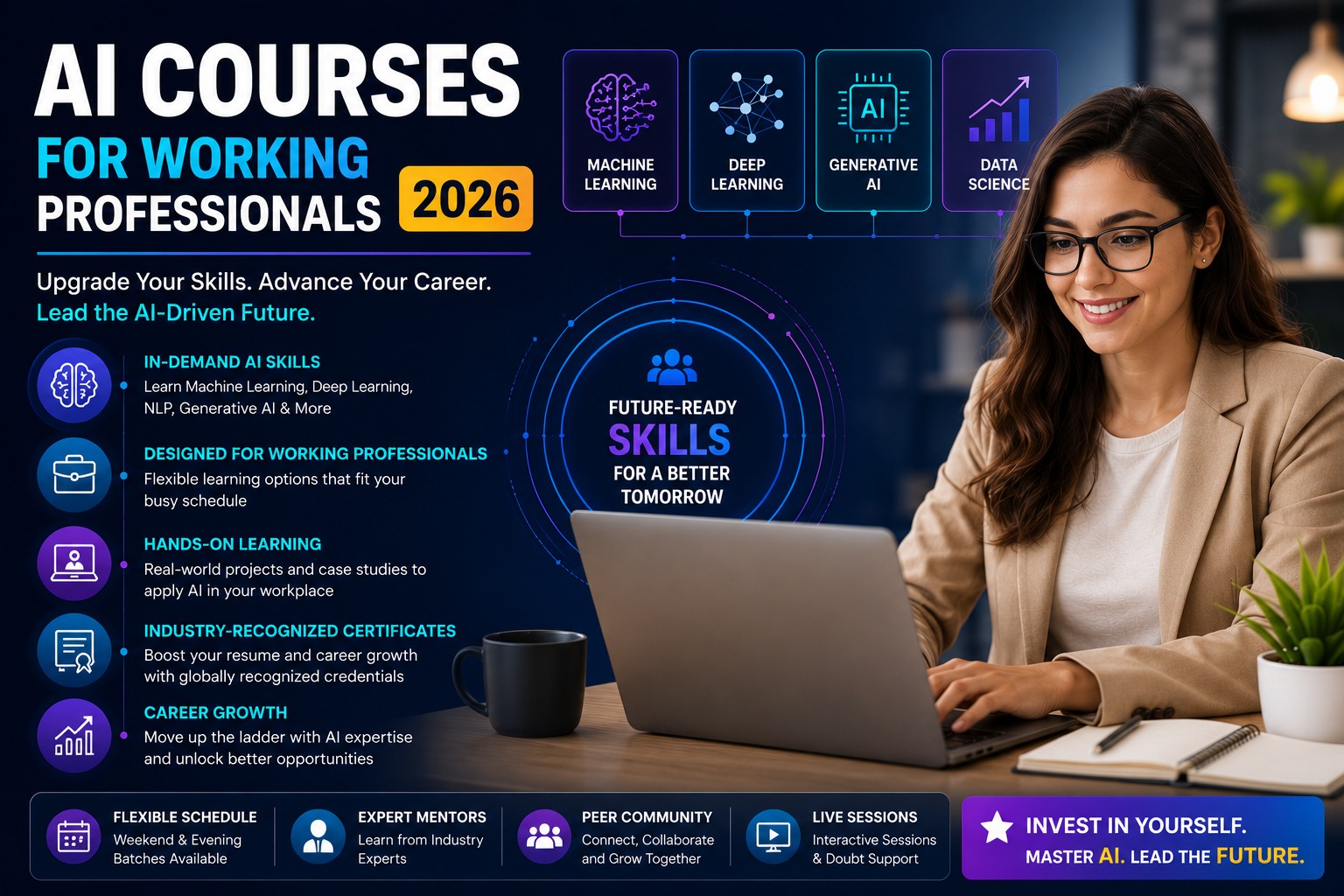
The straight version, before the brochure copy
Most "AI course" pages are written for freshers — people with no job, lots of time, and a first salary to chase. If you're a working professional, your maths is completely different. You have a career, a salary, and maybe a family, and what you're really spending isn't ₹65,000 — it's your Saturdays for the next few months. That makes the wrong course far more expensive than its price tag, because the cost you can't get back is the time.
So this page won't try to convince you AI is the future; you already know. It'll help you judge whether a course is worth your weekends — including ours. There are really only three questions that matter for someone in your position, and the rest is noise: does the schedule actually fit a full-time job, is the syllabus current enough to be worth learning, and is the "placement" real or a resume blast? Here are honest answers to all three.
The 2026 syllabus filter — the one that eliminates most courses
This is where you, as someone already working in tech or near it, have an advantage over a fresher: you can smell a stale syllabus. Use it ruthlessly.
Here's the uncomfortable truth the better reviewers in this space keep pointing out: a large share of AI courses in India are still teaching the 2022 version of the field — Python, scikit-learn, a bit of deep learning — and stopping there. Meanwhile, the actual 2026 interview at a product company or GCC tests whether you can work with large language models, retrieval-augmented generation (RAG), AI agents, fine-tuning, and basic MLOps. Candidates who only know classical ML are getting filtered out, and the course that taught them that gap was its own.
So before anything else, run any course — ours included — through this single filter: does the syllabus genuinely cover LLMs, RAG, agents, and deployment, or does it stop at sklearn and call it "AI"? If the modern layer is missing or bolted on as a bonus video, the course is preparing you for a job market that closed two years ago. Everything below is built the other way round — the modern stack is the spine, not the afterthought.
One quick test you can run in the demo class: ask the instructor to explain how they'd build a RAG system over a company's internal documents, and what they'd watch for. A current, practitioner-taught course answers easily and concretely. A stale one gives you a definition of RAG and changes the subject. The quality of that one answer tells you most of what you need to know.
Who this is for — and who it isn't
A course pitched at everyone fits no one. This one is built specifically for working professionals, which means it's a poor fit for some people — read both columns honestly.
A good fit if you're
- A working software engineer, IT, analytics, or data professional wanting to move into AI/ML
- Mid-career and can't afford to quit — you need evenings and weekends, not a daytime bootcamp
- Aiming to add real AI capability to your current role, or switch into an AI-adjacent one
- Past the "what is AI" stage and want the current stack: LLMs, RAG, agents, deployment
- Able to protect roughly 8–10 focused hours a week alongside your job
Probably not for you if you
- Are a fresher with full days free — a full-time intensive may suit you better and faster
- Want a guaranteed job in 30 days — no honest provider promises that to anyone
- Need a university-branded degree or PG certificate on your resume above all else
- Only want recorded videos to watch whenever — that's a cheaper, self-paced product
- Aren't willing to build real projects — this is hands-on, not a lecture series to attend
The syllabus, built around the 2026 stack
Six modules, taught live on weekends and evenings over roughly five to six months. The classical foundation is there because you need it — but the modern GenAI layer is the backbone, because that's what your interviews and your work will actually demand.
Python & the maths you actually need
Built for people who may have touched code before: practical Python for AI (NumPy, Pandas) and the linear algebra, probability and statistics the later modules lean on — taught efficiently, attached to the code that uses it, so you're not relearning a CS degree on your weekends.
Machine learning that still runs production
Regression, classification, trees, ensembles, clustering — and why each works and where it breaks. Still the bread and butter of a lot of real ML work, and still tested, so it's covered properly: feature engineering, evaluation, the interview-grade depth, without dwelling here longer than your time can justify.
Neural networks you can reason about
Backpropagation from intuition, then hands-on PyTorch — CNNs, sequence models, and how training really behaves. Enough depth to understand what's happening inside the models you'll be using in the modern modules, not a black box you can only call.
LLMs, transformers & generative AI
The module that separates a current course from a stale one. How transformers and LLMs actually work, prompt engineering as a discipline, embeddings, and working with the model APIs (ChatGPT, Claude, Gemini) that every company is now wiring into products. This is load-bearing here, not a bonus.
RAG, agents & retrieval systems
Retrieval-augmented generation done properly — making AI answer from real data instead of hallucinating — plus an introduction to AI agents and the orchestration patterns behind them. This is precisely the material 2026 AI interviews probe and most older syllabi skip, which is exactly why it's a full module here.
MLOps basics, capstone & interview prep
Deploying a model behind an API, the MLOps vocabulary (versioning, monitoring, drift), and a capstone you build, deploy and defend — the project a recruiter actually opens. Alongside it, mock interviews tuned to mid-career AI hiring and placement support that continues after the course ends.
"Placement" — what it honestly means here
This word is abused more than any other in the AI-course market, so let's be precise, because as a working professional you can't afford to be misled by it.
Across this market, "100% placement guarantee" usually means one of two things: a resume blasted to a job portal, or a guarantee wrapped in conditions (perfect attendance, internal tests, an application quota) designed so the institute can decline the claim later. Neither is what you want, and you're experienced enough to see through both. There's also a quieter problem — the headline "average salary" quoted on many pages is often a single outlier, not a median you should plan around.
What we offer instead is placement support we can actually stand behind: resume and LinkedIn work, mock interviews tuned to real 2026 AI loops (the ones that test RAG and agents, not just sklearn), referrals where we have them, and salary-negotiation guidance for mid-career moves. We don't promise a number or a guarantee, because your offer depends on your interviews, which we don't control. The test to apply to anyone, us included: ask to see two or three LinkedIn profiles of working professionals they helped in the last six months, and where those people landed. A real placement operation can show you. A marketing claim will point you to a testimonials page.
How the options actually compare for someone with a job
Not "which is best" in the abstract — which fits a working professional's specific constraints. Honest trade-offs, us included.
| Free / self-paced | Live cohort (us) | University PG program | |
|---|---|---|---|
| Fits around a full-time job | Yes — but you finish alone | Yes — weekend/evening live | Often heavy (11–24 mo) |
| 2026 syllabus (LLMs, RAG, agents) | Varies wildly | Core | Sometimes lags |
| Live doubt-clearing | No | Yes | Yes |
| Finishes with a real project | Rarely | Yes — capstone | Usually |
| Cost | Low | Mid | High (₹1.5L+) |
| Brand-name certificate | No | No | Yes |
If a university brand on the certificate is your single priority, a longer PG program may be worth the time cost. If what you need is current skill and a project, built around a real job, without 18 months or ₹1.5 lakh-plus — that's the slot the live cohort fills. The same applies if your interest leans toward the data-pipeline side rather than models, in which case our data engineering course is the better-fit programme.
What it costs, and how to read the quotes
No "fees on request" runaround — here's the honest context for the Indian market so you can judge any quote, ours included.
AI courses for working professionals in India span a wide range. Self-paced platforms run from a few thousand rupees to around ₹25,000. Live weekend bootcamps typically land between ₹35,000 and ₹90,000. University-branded PG programs (IIIT, IIT-collaboration tracks) run ₹1.5 lakh and well beyond, over 11–24 months. We sit in the live-bootcamp band, priced so a working professional can justify it against the salary move it's meant to enable — without a university-sized fee or timeline.
We share the exact current fee, EMI options, and any running discount on a free intro call — and the first session is free, so you can test the teaching (and run the RAG question above) before you commit a rupee or a single weekend. One honest filter on price: a fair fee buys small live batches, a practitioner instructor, current GenAI material, and real placement work — not a 100-person recorded cohort or a marketing budget. Ask what specifically your fee is paying for.
What working professionals ask us
The real questions from our counselling calls, answered straight.
Can I really learn AI without quitting my job?
I already know classical ML. Is this course still worth it?
What's the schedule, and what if I miss a live session?
Does the course actually cover GenAI, LLMs and RAG, or just classic ML?
Do you guarantee a job or a specific salary?
Is this an AI course or a machine learning course — what's the difference?
I'm a complete beginner to coding. Can I still join?
Test the teaching before you spend a weekend
Book a free intro session with an instructor — not a salesperson. Bring your background, your schedule, and the RAG question from above. We'll give you a straight read on whether this fits your career stage, what it costs, and which roles to aim at.
Book your free intro session