DevOps Course Curriculum
A 12–16 week program covering the tools and concepts that actually come up in Bangalore DevOps interviews. The curriculum gets updated after every batch based on what students report being asked at Flipkart, Amazon, SAP Labs, and similar companies.
Phase 1 · Weeks 1–5
Core Foundations
Linux command line mastery and system administration for production environments, Bash shell scripting for DevOps automation (deployment scripts, health checks, log parsing), Networking fundamentals: TCP/IP, DNS, HTTP, reverse proxies and load balancing — critical for microservices at scale in product companies, Git version control — branching strategies, Git Flow, trunk-based development, and GitHub pull request workflows, Docker fundamentals: images, containers, multi-stage Dockerfile builds, and Docker Compose for local microservices development.
Phase 2 · Weeks 6–10
CI/CD Pipelines & Kubernetes for Product Companies
Jenkins pipeline creation and optimization, GitHub Actions automation, Kubernetes architecture — deployments, services, networking, and RBAC (tested in 80%+ of Flipkart, Amazon, and SAP Labs DevOps interviews), Horizontal Pod Autoscaling (HPA) and cluster scaling strategies used by Swiggy and CRED for peak traffic, Blue/Green and Canary deployments for zero-downtime releases, Helm charts and GitOps workflows with ArgoCD — the standard approach in Bangalore product startups managing 50–200 microservices.
Phase 3 · Weeks 11–16
Cloud Infrastructure, IaC & Real Projects
AWS essentials: EC2, S3, IAM, VPC, RDS, EKS. Terraform for infrastructure provisioning, Ansible for configuration management, Prometheus & Grafana monitoring dashboards, ELK Stack for log management, Basic DevSecOps practices, 4 end-to-end projects + mock interviews.
Complete 8-Module Breakdown — 80 Hours Total
01 · Linux & System Administration8 hrs
Linux command line mastery, file system and permissions, process management and systemd, Bash scripting for DevOps automation — loops, functions, error handling, cron jobs. SSH key management, networking tools (curl, netstat, nmap, tcpdump), log parsing and production incident troubleshooting.
02 · Git & Version Control4 hrs
Git internals — commits, branches, tags, stash. Git Flow vs trunk-based development. GitHub pull requests, code review workflows, branch protection rules. Merge conflicts, interactive rebase, cherry-pick. Pre-commit hooks and conventional commits for CI/CD pipelines.
03 · Docker & Containerization10 hrs
Docker architecture — images, containers, volumes, bind mounts, networks. Writing optimized multi-stage Dockerfiles for production builds. Docker Compose for local microservices development. Container security best practices, image scanning with Trivy, Docker Hub, AWS ECR.
04 · CI/CD Pipelines10 hrs
Jenkins architecture, pipeline-as-code (Declarative Jenkinsfile), shared libraries. GitHub Actions: workflow syntax, matrix builds, composite actions, secrets management. GitLab CI basics. Artifact management and versioning. SonarQube quality gates, automated test integration, rollback automation.
05 · Kubernetes & Container Orchestration16 hrs
Kubernetes architecture — control plane, nodes, pods, deployments, services, ingress, namespaces. ConfigMaps, Secrets, PVs, PVCs, StorageClasses. RBAC and network policies — tested in 80%+ of Flipkart, Amazon, and SAP Labs DevOps interviews. Horizontal Pod Autoscaling (HPA) and cluster autoscaler for peak traffic. Helm charts for package management. ArgoCD for GitOps workflows. Blue/Green and Canary deployment strategies.
06 · AWS Cloud Infrastructure14 hrs
AWS core: IAM (policies, roles, SCP), EC2, S3 (versioning, lifecycle, replication), VPC (subnets, routing, security groups, NACLs), RDS, Route53, CloudFront. EKS for managed Kubernetes, ECR for container registry. CloudWatch metrics, alarms, log insights. AWS cost optimization. Multi-region architecture design. Coverage for AWS Solutions Architect Associate exam topics.
07 · Terraform & Ansible10 hrs
Terraform HCL syntax, providers, resources, data sources, variables, outputs. State management with S3 backend + DynamoDB locking. Workspaces and module structure for multi-environment setups. Writing reusable Terraform modules for AWS VPC, EC2, RDS, EKS. Ansible playbooks, roles, inventory management, Vault for secrets. Configuration drift detection.
08 · Monitoring, Logging & Security8 hrs
Prometheus metrics collection and PromQL queries, alerting rules and AlertManager. Grafana dashboards for production infrastructure health. ELK Stack: Elasticsearch indexing, Logstash pipeline configuration, Kibana visualizations. DevSecOps basics: container scanning, secrets management (AWS Secrets Manager / Vault). SLO/SLA definitions, error budgets, on-call runbooks, incident response.
Total: 80 hours · 8 modules · 4 real projects · Mock interviews from week 8 · Placement support
| Module | Duration | Topics Covered |
|---|
| 01 · Linux & System Administration | 8 hrs | Linux command line mastery, file system and permissions, process management and systemd, Bash scripting for DevOps automation — loops, functions, error handling, cron jobs. SSH key management, networking tools (curl, netstat, nmap, tcpdump), log parsing and production incident troubleshooting. |
| 02 · Git & Version Control | 4 hrs | Git internals — commits, branches, tags, stash. Git Flow vs trunk-based development. GitHub pull requests, code review workflows, branch protection rules. Merge conflicts, interactive rebase, cherry-pick. Pre-commit hooks and conventional commits for CI/CD pipelines. |
| 03 · Docker & Containerization | 10 hrs | Docker architecture — images, containers, volumes, bind mounts, networks. Writing optimized multi-stage Dockerfiles for production builds. Docker Compose for local microservices development. Container security best practices, image scanning with Trivy, Docker Hub, AWS ECR. |
| 04 · CI/CD Pipelines | 10 hrs | Jenkins architecture, pipeline-as-code (Declarative Jenkinsfile), shared libraries. GitHub Actions: workflow syntax, matrix builds, composite actions, secrets management. GitLab CI basics. Artifact management and versioning. SonarQube quality gates, automated test integration, rollback automation. |
| 05 · Kubernetes & Container Orchestration | 16 hrs | Kubernetes architecture — control plane, nodes, pods, deployments, services, ingress, namespaces. ConfigMaps, Secrets, PVs, PVCs, StorageClasses. RBAC and network policies — tested in 80%+ of Flipkart, Amazon, and SAP Labs DevOps interviews. Horizontal Pod Autoscaling (HPA) and cluster autoscaler for peak traffic. Helm charts for package management. ArgoCD for GitOps workflows. Blue/Green and Canary deployment strategies. |
| 06 · AWS Cloud Infrastructure | 14 hrs | AWS core: IAM (policies, roles, SCP), EC2, S3 (versioning, lifecycle, replication), VPC (subnets, routing, security groups, NACLs), RDS, Route53, CloudFront. EKS for managed Kubernetes, ECR for container registry. CloudWatch metrics, alarms, log insights. AWS cost optimization. Multi-region architecture design. Coverage for AWS Solutions Architect Associate exam topics. |
| 07 · Terraform & Ansible | 10 hrs | Terraform HCL syntax, providers, resources, data sources, variables, outputs. State management with S3 backend + DynamoDB locking. Workspaces and module structure for multi-environment setups. Writing reusable Terraform modules for AWS VPC, EC2, RDS, EKS. Ansible playbooks, roles, inventory management, Vault for secrets. Configuration drift detection. |
| 08 · Monitoring, Logging & Security | 8 hrs | Prometheus metrics collection and PromQL queries, alerting rules and AlertManager. Grafana dashboards for production infrastructure health. ELK Stack: Elasticsearch indexing, Logstash pipeline configuration, Kibana visualizations. DevSecOps basics: container scanning, secrets management (AWS Secrets Manager / Vault). SLO/SLA definitions, error budgets, on-call runbooks, incident response. |
| Total | 80 hours | 8 modules · 4 real projects · Mock interviews from week 8 · Placement support |
Tools You Will Be Certified to Use
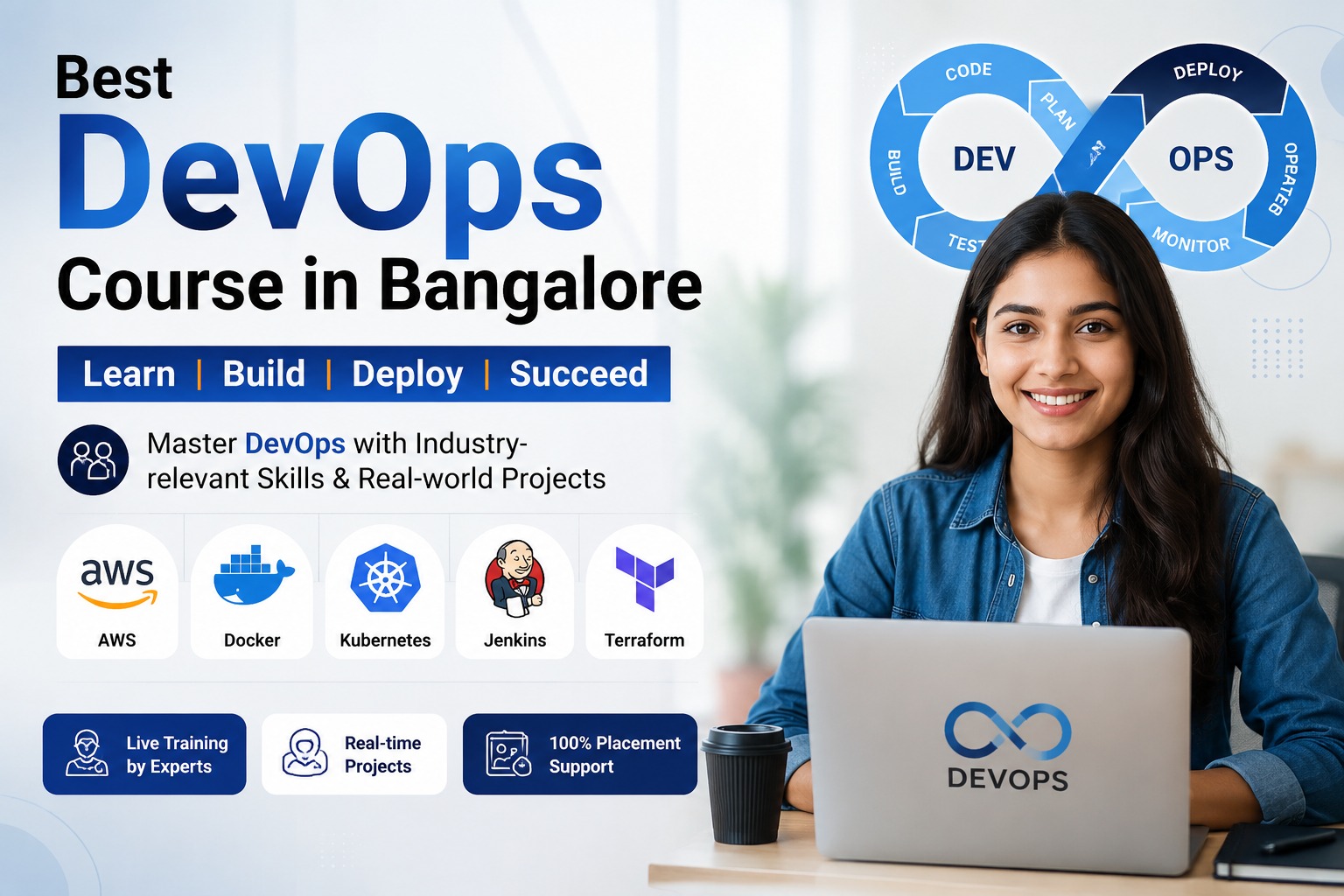
AWS (EC2, S3, EKS, RDS)Azure DevOpsGCP / Google CloudDockerKubernetesJenkinsGitHub ActionsGitLab CITerraformAnsiblePrometheusGrafanaELK StackHelmGitLinux / BashPython scripting
4 Real-World Projects Included
01
End-to-End CI/CD Pipeline
From GitHub commit to production deployment via Jenkins and GitHub Actions.
02
Dockerized Microservices App
Multi-stage builds and Docker Compose orchestration.
03
Kubernetes Cluster Management
Deploy, scale, and monitor a multi-service application on EKS.
04
Terraform Infrastructure Provisioning
Full AWS environment (VPC, subnets, EC2, RDS, S3) built from code.