00 Introduction
Two job posts went up at the same company last quarter, four days apart. One asked for "AI agent development experience." The other wanted "a strong agentic AI background." Scroll down to the responsibilities on both and they were the same job.
So which one is it, and does the distinction mean anything?
If you've gone looking for an answer and come away less certain than when you started, that's a reasonable outcome. Some people use the two terms interchangeably. Others insist on a strict hierarchy. Both camps sound entirely confident, and most articles on the subject pick a definition, present it as settled, and never mention that anyone disagrees.
This one takes the other route. What each term means, why the disagreement exists, what changes at the level of code, and which parts of it are worth anything to your career.
01 What Is an AI Agent?
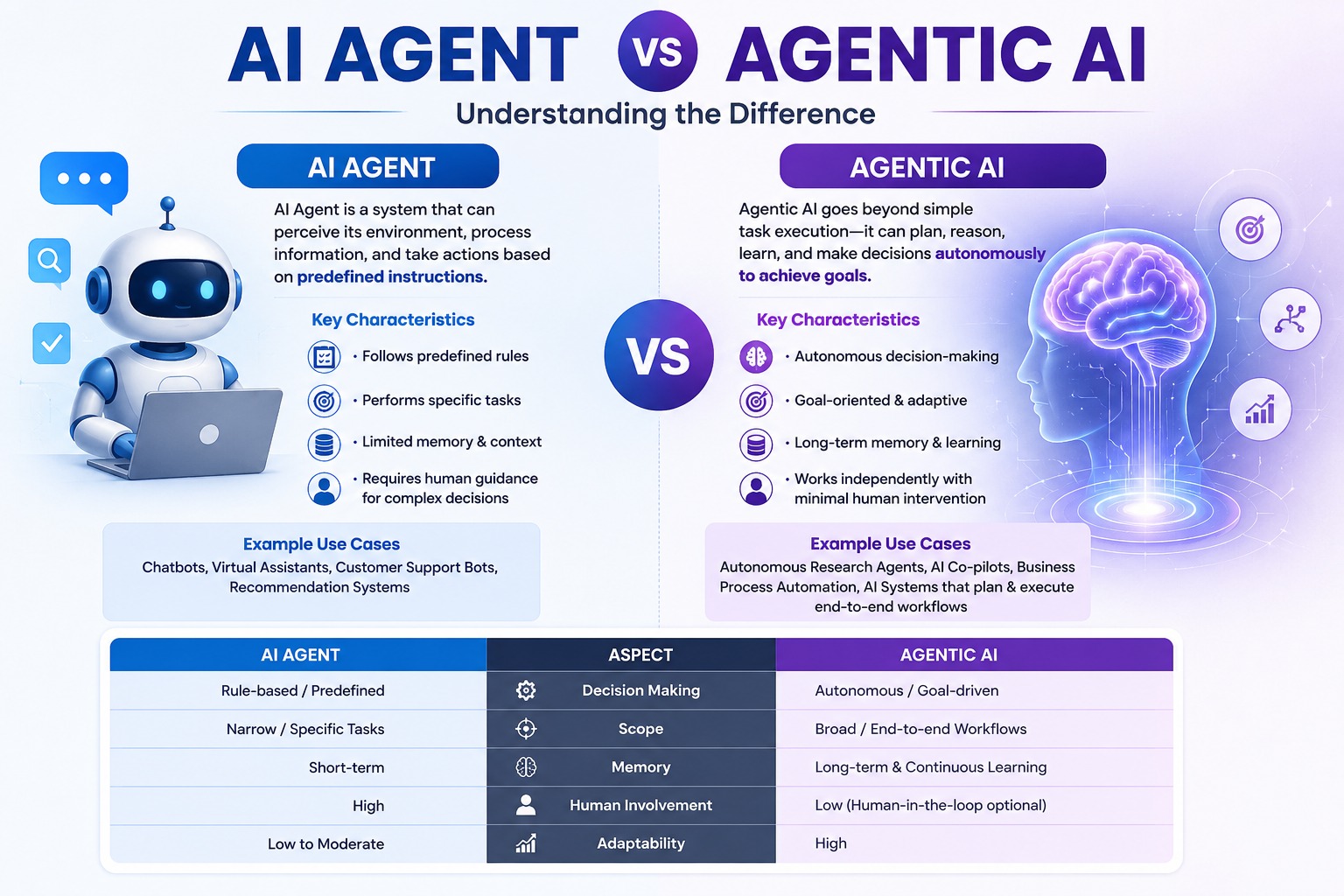
An AI agent is a language model that's been given a goal and a set of tools, running in a loop. It picks a tool, reads what comes back, and decides what to do next. It keeps going until it decides the job is finished.
The loop is the whole thing. Take it away and you have a chatbot.
One request, walked through
Take a real instruction: summarise yesterday's failed payments and email me the list.
Written as a script, I'd have to specify the order myself. Query the payments table. Filter on status. Format the rows. Hit the mail API. Four steps, mine, always in that sequence.
Hand the same sentence to an agent and it works the sequence out. It queries the database, notices the rows come back with customer IDs and no names, calls something else to resolve them, decides thirty failures is enough to want grouping by reason, and only then sends the mail. Nobody told it to look up the names. It hit a gap and filled it.
In a script, the developer decides the path. In an agent, the model decides the path while it runs.
Almost everything people argue about downstream of that turns out to be vocabulary.
02 What Is Agentic AI?
Agentic AI isn't a product category. It describes a property: how much a system pursues a goal and works out its own steps instead of following a route somebody wrote for it.
Used loosely, "agentic AI" covers the whole class of systems that have that property. Used narrowly, which is how most enterprise software companies use it, it means a layer that coordinates several agents. One component plans, splits the goal up, hands the pieces out, and puts the results back together.
You will see both usages in the same week. Occasionally on the same website, three paragraphs apart.
Notice that I've now given you two definitions rather than one. That isn't fence-sitting. It's the actual state of the language, and skipping past it is where most writing on this topic quietly goes wrong.
03 Why the Definitions Conflict
No standards body owns either term. There's no specification, no committee ruling, nothing to appeal to. Both words went into wide circulation somewhere around 2023 through a mix of research papers, product launches and conference talks, and they've been drifting apart since.
The three framings currently in use
The vendor framing
The engineering framing
The marketing framing
The engineering framing has a named source worth reading. Anthropic's engineering team documents this exact distinction, and their version undercuts the tidy hierarchy: they treat "agentic systems" as the umbrella that contains both workflows and agents, and they recommend reaching for the simplest thing that works, which sometimes means building nothing agentic at all. That is close to the opposite of what the vendor framing implies.
So what do you do with three definitions and no referee?
Stop asking is this agentic? That's a question about a label, and the label is contested. Ask this instead:
Who decides the next step, the developer or the model?
That one has an answer. You can put it to any system, to any vendor mid-demo, in any interview. And when somebody can't answer it about software they built themselves, you've learned a great deal about the software.
None of this would matter much if it were only a naming argument. It isn't. The confusion has a price, and it usually gets paid by whoever signs the purchase order. A team decides it needs "agentic AI," buys or builds an orchestration layer for a problem that a router and two tool calls would have closed out, and spends the next quarter debugging autonomy nobody asked for. The reverse happens too, less visibly: a team scopes a genuinely open-ended triage problem as a fixed workflow, watches it fail on every input that doesn't fit the flowchart, and concludes the technology isn't ready.
04 The Agency Spectrum: Six Levels
Once you're asking who decides the next step, the two-category picture falls apart and a dial appears instead. Here it is, from fully developer-controlled to fully model-controlled.
| Level | Who decides the steps | Example | Reliability |
|---|---|---|---|
| 0 | The developer, entirely | An n8n or Zapier flow with no AI in it at all | Highest |
| 1 | Developer; model fills one slot | Classify a support ticket, then route it | High |
| 2 | Developer; model picks a branch | A router sending queries down one of four fixed paths | High |
| 3 | Model, inside a fixed toolset | Single agent, tool-calling loop | Medium |
| 4 | Model, plans and self-corrects | Planning plus reflection; critiques its own output | Lower |
| 5 | Model, delegates to other agents | Multi-agent system with handoffs | Lowest |
Now the part that separates people who've shipped one of these from people who've watched a lot of videos about them.
Most of the value being delivered in 2026 sits at levels 1 to 3.
Levels 4 and 5 demo beautifully, and that's not sarcasm. A planning agent that decomposes a goal, spins up workers and reports back is genuinely impressive to sit and watch. It's also the thing most likely to get quietly rewritten as a level 2 router about six weeks after launch, once it turns out nobody can debug it, the token spend has tripled, and the failures are hard to even describe in a ticket.
We see the small version of this in class constantly. Somebody brings a capstone idea with four agents negotiating with each other, and the moment you ask what the thing is supposed to do for whoever uses it, the design collapses into a router and two tool calls. That's not a failure of ambition. The collapsed version is the one that works on demo day, and it's usually the one that gets them hired.
Placing something real on the dial
A support bot that reads an incoming email, works out whether it's a refund request, and drops it in the right queue is a level 1. Give it four possible destinations and let the model choose between them and you're at level 2. Let it decide for itself whether to check the order database before answering, and you've crossed into level 3, which is also the point where you start needing to log what it did. Most companies describing their support automation as "agentic AI" are running a level 2. That's not a criticism of them. A level 2 that works beats a level 5 that's down.
Which is why building workflows before agents is the less glamorous route and the faster one. The engineers who skip the detour through level 5 aren't the ones who know the most about multi-agent architecture. They're the ones who opened by asking how little agency the problem actually required.
05 Where Does Generative AI Fit?
Worth pinning down, since all three terms tend to appear together and get flattened into one lump.
Generative AI is about what a model can produce. Text, code, images, audio. A capability. You ask, it generates.
An agent runs a generative model as its reasoning engine but wraps three things around it that the model doesn't have on its own: tools it can call, some form of memory, and a loop that lets it act more than once.
The cleanest illustration is one you've probably used without thinking about it. ChatGPT answering from what it already knows is generative AI. ChatGPT searching, running Python, reading its own output, spotting that the number looks wrong and trying again is agentic. Identical model underneath. Different architecture around it.
Generation is a capability. Agency is an architecture.
06 Side-by-Side Comparison
| Workflow / low agency | Agent / high agency | |
|---|---|---|
| Controls the flow | Developer, at build time | Model, at runtime |
| Predictability | Same input, same path | Same input, possibly a different path |
| Cost per task | Fixed, known in advance | Variable, occasionally alarming |
| Latency | Predictable | Depends how many loops it takes |
| Debugging | Read the logs, find the step | Read a trace, infer the reasoning |
| Memory | Usually not needed | Context window, sometimes a persistent store |
| Typical failure | Breaks loudly at a known step | Loops, burns tokens, returns something confidently wrong |
| Best fit | Steps known and stable | Steps depend on what turns up along the way |
Sit with the failure row for a second, because it's the one that costs money. A broken workflow announces itself. A misbehaving agent frequently doesn't. It returns a plausible answer resting on a tool call that silently came back empty, and unless somebody is checking, that reads as success.
Which is why observability shows up in every serious job description in this field, and why it's the part most self-taught candidates have never touched.
07 The Difference in Code
Two examples, both stripped down to almost nothing.
# WORKFLOW — the order is mine. The model has one job: classify.
ticket = fetch_ticket(ticket_id)

category = llm(f"Classify as billing, bug, or other:\n\n{ticket.body}")

if category == "billing":
    assign_to("finance-queue")
elif category == "bug":
    create_jira_issue(ticket.title, ticket.body)
    assign_to("eng-queue")
else:
    assign_to("human-review")

send_acknowledgement(ticket.customer_email)
Read it once and you know what will happen. Every time, in that order.
# AGENT — I supply tools and a goal. What happens next is not up to me.
tools = [search_docs, query_database, create_jira_issue, send_email]

messages = [{"role": "user",
             "content": "Handle ticket #4471. Tell me what you did."}]

for _ in range(MAX_STEPS):
    response = llm(messages, tools=tools)   # <-- control passes to the model here

    if not response.tool_calls:
        print(response.text)                # it decided it was done
        break

    for call in response.tool_calls:
        result = run_tool(call.name, call.arguments)
        messages.append(tool_result(call.id, result))
One line matters more than all the others and it's marked. Above it I'm in charge. Below it I'm not, and I'll find out what the model chose by reading the trace afterwards.
MAX_STEPS isn't decoration either. Without a cap, an agent that gets confused will loop, and it will keep paying for the privilege the entire time. Every framework ships some version of that guard, and every engineer who has run an agent against real data has a story about the afternoon they discovered why.
What people actually build this with
LangGraph when you want explicit control over state and flow, CrewAI for multi-agent setups, the OpenAI Agents SDK for something lighter, MCP for standardising how tools and context get plumbed in. If you'd rather work through the lower levels of the dial visually before writing any of this by hand, n8n and the no-code route will get you further than people expect.
08 When Not to Use an Agent
Don't use an agent when the steps are already known and stable, when the process has to be auditable, when a user is waiting on the result, when a wrong action can't be undone, or when the cost has to be predictable in advance. Underrated skill, and it comes up in interviews far more than the definitions do.
Handing a sequence you already know to a model that has to rediscover it on every run costs more, takes longer, and fails in more imaginative ways.
If you can draw the flowchart, build the flowchart. There's no prize for the fancier architecture.
Finance, healthcare, insurance, anything with a compliance trail. "The model decided" is not a sentence you want to say to a regulator asking why an action was taken on a particular account.
Deterministic flow with logged decision points. Keep the model on classification and extraction, not on the action itself.
Agents loop, loops take seconds, and if a human is sitting there then each extra reasoning step is something they're paying for with their afternoon.
Pre-compute what you can, and put agentic work behind a queue rather than a spinner.
Sending money. Deleting records. Emailing four thousand customers. The question was never whether it usually gets it right, because it usually will. The question is the run where it doesn't.
A human approval gate in front of anything irreversible, plus the smallest toolset that can still finish the job. An agent that can only read costs you a wasted API call. An agent with write access to production costs you an incident review.
A workflow's per-run cost is arithmetic; you can put it in a spreadsheet and forecast a year. An agent's depends on how many times it chose to loop, and that distribution has a tail.
Hard step caps and a per-run budget ceiling. Plenty of teams have shipped something that averaged fine and then met the request that took forty steps.
None of that means don't build agents. It means constrain them, and know which constraint you're reaching for before you start.
09 CV, Interviews and Salary
Take the CV question first. Job posts in India throw "AI agent," "agentic AI," "LLM engineer" and "AI automation engineer" around fairly loosely, sometimes for the same role at the same company in the same quarter. Optimising a CV for a keyword is a losing game when the keyword won't hold still. What travels across all four titles is a system you built, deployed, and can defend when somebody pushes back on your choices. One working project you can talk about for twenty minutes beats a list of six framework names, and it isn't close. If you want the broader picture of the AI skills employers screen for, that's a separate conversation, but the principle holds across all of them.
Interviews aren't testing your definitions. They're testing judgement. Whether you can scope a problem to the right level of agency, cope with a tool that fails or hands back garbage, keep the spend bounded, tell whether the output was any good, and reconstruct what the system actually did after the fact. It helps to know how AI interviews are structured before you walk into one.
Five questions worth having answers to
"When would you not use an agent?" A filter, and a brutally effective one. Somebody who has shipped an agent has opinions and usually a grievance. Somebody who has only followed tutorials treats agents as strictly better than workflows, because every tutorial they watched was selling them on agents, so the question doesn't parse.
"How would you stop an agent looping forever?" Step caps. Budget caps. Loop detection. A termination condition the model can actually satisfy rather than one it will talk itself out of.
"A tool call returns an empty result. What happens next?" Error handling, which is precisely where demo projects fall apart.
"How do you know whether the agent did a good job?" Evaluation. Weakest area for most self-taught candidates, and the thing hiring teams have started caring about most, because it's the difference between a system you can improve and one you can only hope about.
"Walk me through something you built and what you'd change." This is the actual interview. Everything before it was warm-up.
What it pays in India
Those numbers shift a lot with city, company type and what you can put on a screen, and they overlap heavily with what LLM engineers actually earn. Ranges, not promises. Anyone quoting you one confident figure is selling something.
10 A Sensible Learning Order
The common mistake is starting at level 5, because level 5 is what the impressive demos show. It's a slow way to learn, since a multi-agent system that fails gives you very little information about which part failed.
Workflow automation, then one model call inside it. APIs, webhooks, JSON, error handling. Then classification or extraction as a single step.
Tool calling, then a single agent. Understand the mechanism before you let anything loop on it. One goal, three tools, a step cap.
Evaluation and observability. Multi-agent last. Step five is the one almost everybody skips, and the one that turns a portfolio project into something a team would run.
That's roughly the path our live agentic AI program follows, with something built at each stage rather than assembled from tutorials afterwards. It isn't the only route. The order matters considerably more than where you learn it.
11 Frequently Asked Questions
Is agentic AI the same as an AI agent?
Is agentic AI just marketing?
Do I need Python to build AI agents?
Is RAG agentic?
Is n8n enough, or do I need LangGraph?
Which should I learn first in 2026?
12 The Short Version
There aren't two categories here. There's a dial, running from I wrote every step to the model works it out, and every real system sits somewhere along it.
Anybody telling you their product is fully agentic is describing their marketing rather than their architecture. The skill that gets you hired, and keeps things running once you are, is picking the right position on that dial and being able to defend the choice.
It's usually lower than the demo made it look.
Sources referenced: Anthropic's engineering write-up on building effective agents; the LangGraph documentation. Salary figures are indicative ranges drawn from Indian market listings and vary by city, company type and demonstrable experience.
Evaluating your options?
Our agentic AI program follows the order above — workflows, then tool calling, then agents, then evaluation — with something built and deployed at each stage. The first session is free, and you'll know by the end of it whether it's for you.
See what the program covers →