AI training in the USA for people who actually want to finish.
The US AI-course market is split in two: $59 self-paced courses almost nobody completes, and $20,000 enterprise programs built for Fortune 500 teams. If you're an individual or a small team, neither fits. This is the middle — live online cohorts of ten, a real instructor, and projects you build and keep.
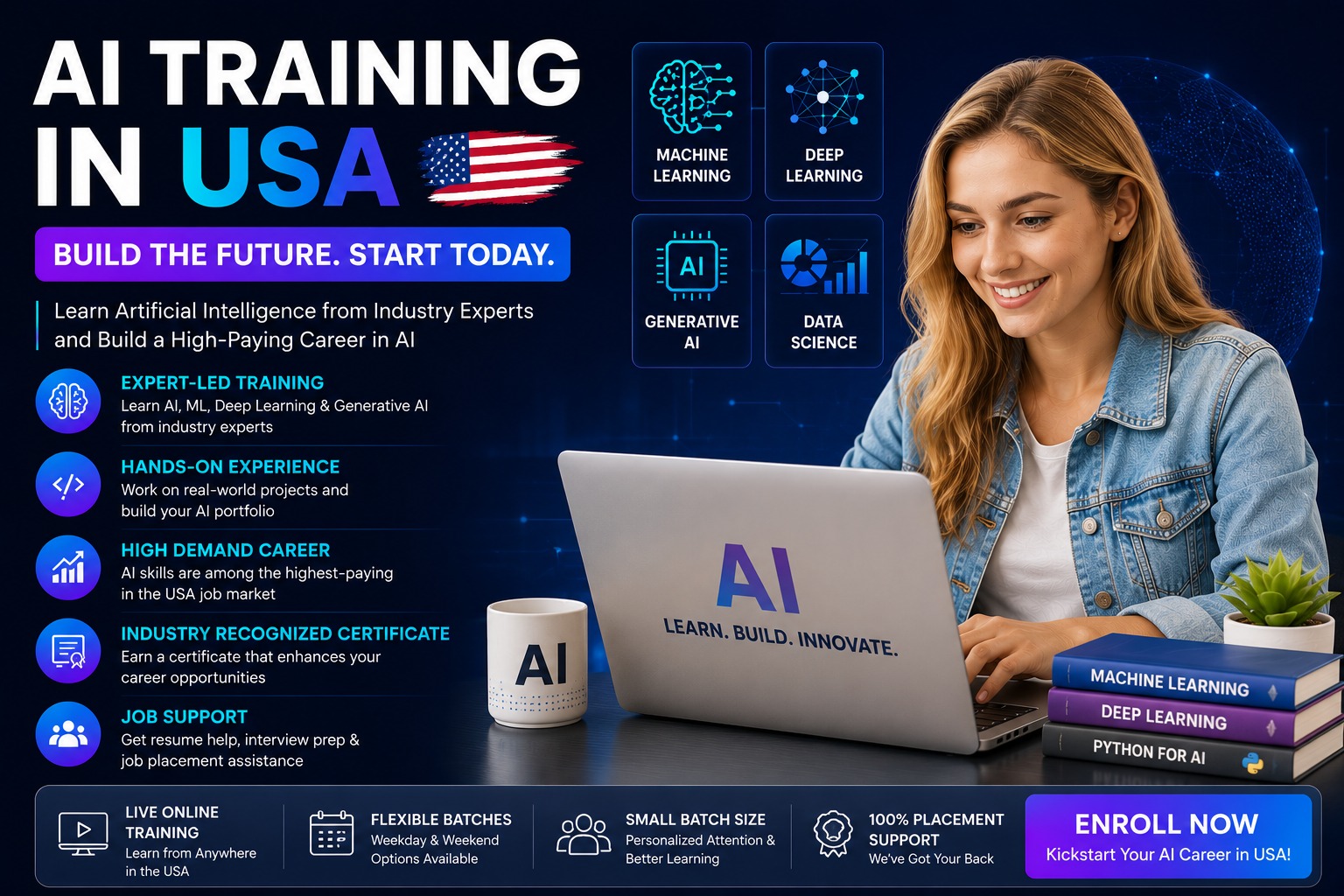
The straight version, before the sales pitch
Here's a number the course pages don't advertise: self-paced online courses have brutal completion rates. People buy a $59 subscription, watch two videos, and never return — and "the curriculum you didn't finish wasn't worth it, no matter how good it looked on paper." That's the real problem with most AI training, and it isn't the content. It's that nothing holds you to finishing.
The enterprise providers solved this with live, instructor-led programs — and priced them for companies, not people. A custom corporate AI program runs into five figures because it's sold to L&D departments by the seat. Brilliant if your employer pays. Useless if you're a working professional, a career-switcher, or a five-person startup paying out of pocket. ShifttoTech exists in the gap between those two: the accountability and real instruction of the live format, at a price an individual can actually justify.
Why AI skills are suddenly non-optional in the US
This isn't hype talking — it's what the 2026 enterprise data actually shows. The gap between people who can use AI well and people who can't is widening into a measurable career divide.
The numbers are stark. Industry research puts the cost of the AI skills shortage at roughly $5.5 trillion in cumulative losses, with over 90% of global enterprises projected to face critical AI skills gaps. On the demand side, AI talent is outpacing supply by about 3.2 to 1 — roughly 1.6 million AI roles posted against only around 518,000 qualified candidates. That imbalance is the entire reason this is a good moment to build the skill: scarcity is on your side.
And it's not only specialist roles. Surveys find that around four in five US employees want more AI training, while only a minority of executives are actively helping their teams get it — which means the responsibility, and the advantage, often falls to the individual who takes initiative. The professionals who invest in structured AI skills now are the ones who show up to 2026's job market already fluent, while everyone else is still asking what a prompt is.
The practical takeaway: AI fluency has crossed from "nice differentiator" to "baseline expectation" in a huge share of US knowledge work. You don't need to become a machine-learning researcher — but being the person on your team who can actually build with AI, not just chat with it, is now one of the highest-leverage moves available to a working professional. That's specifically what this training is built to make you.
The three ways to learn AI in the US — honestly compared
No format is universally "best." But for most individuals and small teams who need to actually finish and have something to show, one of these fits far better than the others. Here's the honest trade-off.
| Self-paced ($59–250) | Live cohort (us) | Enterprise ($20k+) | |
|---|---|---|---|
| Accountability to finish | Low — willpower only | High — live schedule | High |
| Real instructor feedback | No | Yes — live Q&A | Yes |
| Cohort / peers | No | Yes — group of 10 | Yes |
| Built for individuals | Yes | Yes | No — for companies |
| Price for one person | Low | Mid | Very high |
| You finish with a project | Rarely | Yes — capstone | Sometimes |
The pattern is clear: self-paced wins on price and loses on completion; enterprise wins on everything except being available to a normal person at a normal price. The live cohort is the format that gives an individual the structure that actually gets them to the finish line — which, given the completion data, is the thing that matters most.
Who this is for — and who it isn't
We'd rather you self-select out now than enroll into the wrong thing. Read both columns.
A good fit if you're
- A US-based professional who wants to actually use AI at work, not just hear about it
- A career-switcher moving toward AI/ML or AI-adjacent roles
- A small team or startup (3–10 people) wanting to upskill together affordably
- Someone who has tried a self-paced course and never finished it
- After real, built projects you can show — not just a completion badge
Probably not for you if you
- Want a purely self-paced, watch-whenever experience — that's a cheaper product
- Need a university-accredited degree or a Big-Four brand name on the certificate
- Are a 500-person enterprise needing a fully custom L&D rollout
- Can't commit to live sessions at any scheduled time
- Just want a quick certificate to list, with no intention of building anything
What you'll actually learn
Practical, current, and built around what people are genuinely hired and paid to do with AI in 2026 — prompt engineering, building with AI APIs, RAG, and shipping something real. Each module ends with something you made.
How modern AI actually works (without the hype)
What large language models are doing under the hood — enough to use them well and know their limits. The vocabulary, the capabilities, and the honest failure modes, so you stop guessing and start reasoning about AI.
Prompt engineering as a real discipline
The transferable skill the enterprise guides all name first: writing clear, structured instructions that get reliable output across ChatGPT, Claude, Gemini, and Copilot. Context-setting, iteration, and evaluation — treated as engineering, not luck.
Building with AI APIs
Going from "I use ChatGPT" to "I built a tool with the API." Calling models programmatically, handling responses, and wiring AI into a real workflow — the step that separates AI users from AI builders.
Retrieval-augmented generation (RAG) & grounding
How to make AI answer from your own data instead of hallucinating — embeddings, retrieval, and grounded responses. RAG is the technique behind most serious enterprise AI in 2026, and it's surprisingly learnable when taught live.
AI governance, ethics & the limits that matter
Bias, privacy, data handling, and where AI should not be trusted — the responsible-use layer every credible enterprise program now includes, taught practically rather than as a compliance lecture.
Build and present one real AI project
You scope, build, and present an AI tool or workflow that solves an actual problem from your work or interests — the thing you'll show an employer, a client, or your team. The deliverable that proves the course did its job.
Where AI skills actually take you in the US job market
Not vague "future-proofing" — the concrete roles and shifts that AI fluency opens, whether you're switching careers or trying to stay valuable in the one you have.
For most people, the payoff isn't becoming an "AI engineer" overnight — it's becoming dramatically more effective and more promotable in the role you already hold, plus opening the door to AI-adjacent roles that didn't exist three years ago. Knowledge workers who use AI well report saving meaningful hours every week, and the people who can build small AI tools and workflows — not just use chatbots — are the ones being pulled into the new, better-paid AI-adjacent positions: AI specialists, prompt and workflow designers, AI product roles, and the "AI champion" inside non-technical teams.
There's also a defensive case, and it's honest to name it: the roles most exposed to AI are the ones held by people who don't use it, while the same tools make the people who do use them far more productive. Learning to direct AI rather than compete with it is, for a lot of US professionals in 2026, simply the most rational career insurance available. The goal of this course is to put you firmly on the productive side of that line — with a built project to prove it.
How we compare to the AI training you've already seen
You've probably got tabs open on a few of these. Here's the honest read on where each fits — and where we don't pretend to compete.
vs. Coursera, Udemy & self-paced platforms
They're cheaper and start instantly — genuinely the right choice if you're highly self-disciplined and just want reference material. Where they lose is finishing and feedback: pre-recorded video can't answer your specific question or notice you've stalled. If you've bought one of these and not completed it, that's the gap we're built to close.
vs. Harvard, Wharton & university certificates
If what you need is a prestige brand name on a certificate for your résumé, those programs deliver exactly that, and we won't pretend to match the brand. What they're less focused on is sending you out with a working tool you built. We optimize for capability and a finished project, not for a logo — a different goal at a very different price.
vs. Deloitte, Correlation One & enterprise providers
These are excellent — and built and priced for companies rolling out AI to hundreds of employees, often $20,000 and up. If your employer is buying, take it. If you're an individual or a small team paying your own way, they're simply not sold to you. That's the entire reason we exist.
In other words, we're not trying to beat Harvard at being Harvard or Deloitte at being Deloitte. We occupy the spot none of them serve: live, instructor-led AI training an individual or small US team can actually afford and actually finish.
Why live, when self-paced is cheaper?
A fair question, with a data-backed answer rather than a slogan.
Because the format that's cheapest to buy is often the most expensive to waste. The recurring finding across the US learning market is that self-paced courses suffer from low completion — the flexibility that sells them is the same flexibility that lets life crowd them out. Live cohorts fix that structurally: a scheduled session you've committed to, with an instructor expecting you and peers alongside you, does the work that willpower alone usually can't. Cohort formats also give you immediate feedback (typically same-session, versus days of waiting on a forum), real Q&A, and a network that often outlasts the course.
None of that requires being in a US classroom. Our training is fully online and live, with evening-friendly US time-zone batches and every session recorded for revision — so you get the accountability and instruction of the live format without a commute or a five-figure invoice. If your interest runs deeper into building models and pipelines, our data engineering programme covers that adjacent, more technical path, and you can also browse our core AI course for the full curriculum.
Pricing, in plain terms
No "request a quote" wall. Here's the honest context for the US market so you can place any price you're shown.
The US AI-training market runs roughly like this: self-paced courses from around $59 to $250; university and brand certificates (Harvard, Wharton, Caltech) from several hundred to a few thousand dollars; and custom enterprise programs from roughly $20,000 to $70,000+ for a team. We sit deliberately between the self-paced floor and the enterprise ceiling — priced so an individual or a small team can afford live instruction without a corporate budget.
We share the exact current fee, payment options, and any small-team discount on a free intro call — and the first session is free, so you can judge the teaching before you pay for anything. One honest filter for any AI course you compare: ask what you will have built by the end, and whether you keep it. A real course produces a project in your hands; a content library produces a completion screen.
Questions we get from US learners
The real ones, answered straight.
Is this AI training available across the USA?
How is this different from a Coursera or Udemy AI course?
Do I need to know how to code?
Can my small team or startup train together?
What will I actually be able to do after the course?
How long is the program and what does it cost?
Is it too late to learn AI in 2026?
Will I get a certificate?
Does this prepare me for an AI/ML engineering career specifically?
How to choose your AI training (a 60-second decision guide)
Forget the marketing for a moment. Run yourself through these four questions and the right format usually becomes obvious — even if the answer isn't us.
1. Have you finished a self-paced course before? If you reliably complete async courses on your own steam, a $59 self-paced AI course may genuinely be all you need — start there and save your money. If you've started and abandoned them (most people have), the live format exists precisely because willpower isn't a reliable plan.
2. Do you need a brand name, or a capability? If a recruiter or your industry specifically values a Harvard or Wharton certificate, pay for the brand — it's a real asset in some contexts. If what you need is to actually do the work and show it, optimize for the course that ends with a built project, not a famous logo.
3. Is someone else paying? If your employer funds training, the enterprise programs are excellent and you should use them. If it's your own money, those aren't realistically on the table — and the live-cohort middle is the only place you get real instruction at an individual price.
4. Will you actually show up? The live format's strength — a fixed schedule — is also its one demand. If you genuinely can't commit to scheduled sessions, be honest with yourself and pick async. If you can, that same schedule is the thing that finally gets you across the finish line.
Work through those honestly and you'll know which option fits. If the answers point you to live, small-group, project-based training at a price a person can pay — that's exactly what we built, and the first session is free so you risk nothing finding out.
Sit in on a session before you decide
Book a free intro session — meet the instructor, see how the live format works, and ask anything. No payment to attend, and no obligation after. Judge the teaching, then decide.
Book your free intro session