Live Online · Weekend Batches · Batch Size 10
Generative AI Course — Build With LLMs, Not Just Learn About Them
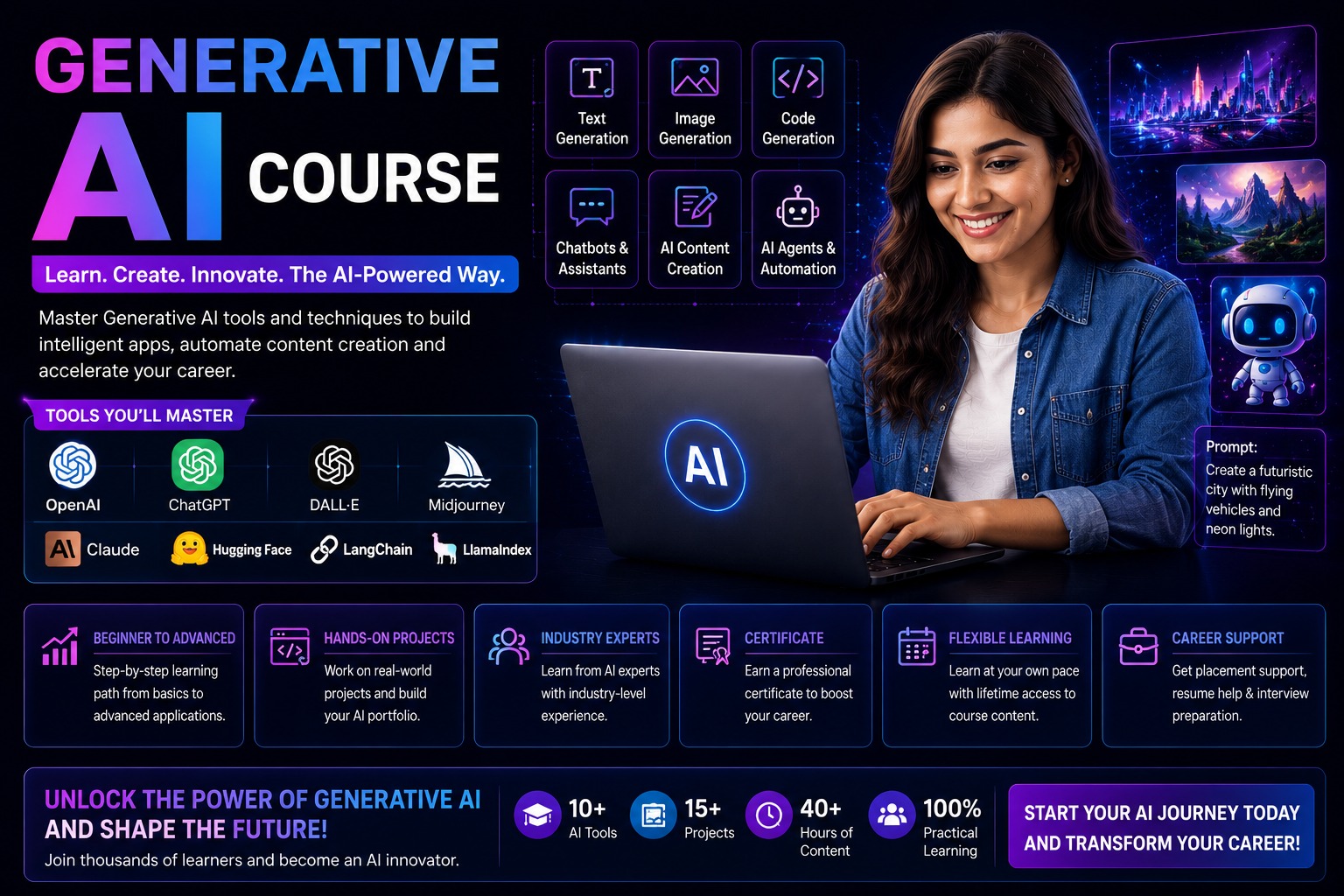
A live generative AI course for people who want to ship GenAI applications. Prompt engineering, RAG with vector databases, LangChain, LoRA fine-tuning, and real production deployment. ₹35,000, with placement support. Next batch: October 4, 2026.
16 weeks
Live weekend classes, built around a full-time job
4 projects
Deployed GenAI apps on your GitHub, not notebook demos
10 students
Maximum batch size. Direct instructor time.
₹35,000
Published here. Compare it with anything.
Why a Dedicated Generative AI Course in 2026?
Almost nobody is hiring you to train a foundation model. That work happens at a handful of labs with budgets you and I will never see.
What companies are hiring for, in very large numbers, is the layer above it. Engineers who can build a retrieval system that doesn’t hallucinate. Who can wire tool calling into an LLM app without it falling over in production. Who can look at a ₹4 lakh monthly API bill and know which three changes cut it in half.
That’s a different skill set from a machine learning degree, and it’s closer to software engineering than most people expect.
Read a GenAI job description carefully and you’ll usually find the same things: Python, an LLM API, RAG, some vector database, LangChain or similar, and something about deployment. Occasionally fine-tuning. Rarely anything about training from scratch. This course teaches exactly that stack, hands-on, over sixteen weeks.
One honest note before you go further. “GenAI engineer” covers a wide spread of jobs right now, from serious platform work to roles that are essentially prompt writing with a better title. The parts of this page about salaries and about which jobs are real are written with that in mind.
New to all of this? Start with our free explainer, What is Generative AI?, then come back. If you want the complete AI engineer path including ML, deep learning and computer vision, the full AI Course is the wider route.
This Course, the AI Course, or the Agentic AI Course?
We run three adjacent programmes at the same price, which is genuinely confusing from the outside. Here’s the honest breakdown.
| Generative AI (this page) | AI Engineer Program | Agentic AI | |
|---|---|---|---|
| What you build | RAG systems, LLM apps, fine-tuned models, deployed GenAI services | The full path: ML models, deep learning, NLP, computer vision, plus GenAI | Autonomous agents, multi-agent systems, LangGraph and CrewAI workflows |
| Suits you if | You can already code a bit and want to build with LLMs, fast | You want the complete AI foundation and have time for it | You already understand LLM apps and want the agent layer |
| Needs going in | Basic Python. We cover the rest. | Basic Python. Broader ground to cover. | LLM application experience helps a lot |
| Job titles it points at | GenAI engineer, LLM engineer, AI application developer | AI engineer, ML engineer, data scientist | AI agent engineer, automation engineer |
| Duration and fee | 16 weeks · ₹35,000 | 16 weeks · ₹35,000 | See the Agentic AI Course |
The short version: this is the deep path, the AI course is the wide one. If your goal is to be employable as an LLM application engineer in four months, take this. If you want the broader foundation and are fine spending longer to get to the LLM work, take that.
Still unsure? Book the counselling call and describe what you actually want to build. We’ll tell you which one fits, including when the answer is neither.
Who This Course Is For
Six kinds of people turn up in these batches.
The backend developer who has called the OpenAI API
You wired up a chatbot, it worked, and then you had no idea how to make it use your company’s documents, or stop it inventing things. This course is aimed squarely at you.
The data analyst
Python and SQL are fine, you’ve built dashboards, and you can see where this is going. The jump from analysing data to building applications on top of models is shorter than it looks.
The ML-adjacent engineer who did a course in 2021
You learned scikit-learn and some deep learning, then the whole field moved. You don’t need to relearn gradients. You need RAG, agents and deployment.
The QA or support engineer switching
Doable, and slower than the marketing suggests. Budget extra time on Module 1 and don’t measure your pace against the developers in the batch.
The fresher
Your degree isn’t the problem. The absence of anything deployed is. Four working projects on GitHub change that conversation entirely.
The senior engineer whose company just asked them to ‘add AI’
Extremely common in 2026. You need the deployment and cost-control modules more than the theory.
And who shouldn’t take it. If you want to use ChatGPT better at work rather than build things with it, this is the wrong purchase. Read the free prompt engineering guide instead and save your ₹35,000. That’s not false modesty; people in that group tend to drop out around Module 4 and nobody enjoys that.
Prerequisites — the Python and Maths Questions
These two come up in nearly every counselling call, so let’s be specific rather than reassuring.
Python
You need to be able to write a function, use a dictionary and a list, and make an HTTP request to an API. That’s roughly it.
If you can read that sentence and think “yes, I can do those,” you’re ready. Module 1 covers what’s missing, including the ML concepts you actually need. If you’ve never written any code at all, you’ll manage, but expect the first three weeks to take real effort.
Maths
Much less than you fear. No calculus. No deep statistics.
The reason is structural: you aren’t training models from scratch, you’re building on top of ones that already exist. You need to understand what an embedding represents and why cosine similarity matters for retrieval. You don’t need to derive backpropagation, and if anyone tells you otherwise about a GenAI application course, they’re padding the syllabus.
Everything else
- Laptop. Anything that runs a browser and Python. No GPU needed. You work against APIs, and the one fine-tuning module runs on Colab or a rented GPU hour.
- Time. Ten to fifteen hours a week including class. This is the requirement people underestimate every single batch.
- API budget. A few hundred rupees across the whole course if you’re careful, and we teach you how to be. Most learners spend less than ₹1,000 total.
- English. Documentation, papers and error messages. Technical and repetitive, so it gets familiar fast.
- Who should wait. If you’re in a notice period or heading into a release crunch, take the next batch. Modules 4 and 5 build directly on each other and missing two weeks in the middle is painful.
Generative AI Course Syllabus — 8 Modules
Sixteen weeks, eight modules. Every one of them ends with something running, not a set of notes.
Module 1 · Python & ML Foundations for GenAI
The practical Python you need, then only the ML concepts that come up later: what a model actually is, what training versus inference means, what an embedding represents, and how tokens get billed.
We skip the rest. You will not spend three weeks on gradient descent for a job where you’ll never train a model from scratch. If you already write Python daily, this module is revision and you can treat it that way.
Module 2 · How LLMs Work — GPT-5, Claude, Gemini
Transformers at the level you need to reason about behaviour, not to implement one. Tokens, context windows, temperature, what “the model forgot” actually means.
Then the practical half: choosing a model. Each of the big three has different strengths, different pricing per million tokens, and different latency characteristics. Most teams pick one because somebody read a benchmark on Twitter. You’ll learn to pick on cost and latency for your specific task, which is what an interviewer wants to hear.
Module 3 · Prompt Engineering
Structured prompting, few-shot examples, chain-of-thought, output formatting, and evaluation.
The emphasis is on techniques that survive model updates. A prompt trick that worked on one model version and broke on the next isn’t engineering, it’s superstition. You’ll build a small evaluation harness so you can tell the difference when your prompts stop working.
Deeper reading: the six prompt engineering techniques that matter.
Module 4 · RAG & Vector Databases
The module that gets the most time, because it’s what most GenAI jobs actually involve.
You build a document Q&A system end to end: chunking, embeddings, a vector database, retrieval, and grounding the answer so the model stops inventing things.
The part worth knowing in advance: most RAG systems fail at retrieval, not generation. The model isn’t the problem. Your chunks are too big, or too small, or split mid-sentence, or your embedding model doesn’t understand your domain vocabulary, or you’re retrieving five documents when the answer needed three specific paragraphs. We spend real time on evaluating retrieval quality, which is the thing most tutorials skip entirely and most interviewers ask about.
Background reading: what RAG actually is.
Module 5 · LLM Apps with LangChain
Chains, memory, tool calling, structured output, and error handling for a system that fails in ways normal software doesn’t.
The distinction that matters here is between a notebook demo and an application. A demo works once, on your machine, with your example. An application handles a model timeout, a malformed JSON response, a user asking something out of scope, and a rate limit at 4 PM on a Tuesday. We build the second kind.
Module 6 · Fine-Tuning with LoRA
How to adapt an open-source model to your domain using LoRA on affordable hardware. Dataset preparation, training, evaluation, and deployment of the result.
Equally important: when not to fine-tune. Most people who want to fine-tune should be improving their retrieval instead. Fine-tuning teaches a model style, format and domain vocabulary. It does not reliably teach it facts, and it doesn’t stop hallucination. Getting that distinction right in an interview separates you from most candidates immediately.
Module 7 · Intro to AI Agents
What agents add beyond a chat interface: tool use, multi-step workflows, and the planning loop.
Deliberately an introduction. Agents are a large enough subject to deserve their own programme, and we have one. This module gives you enough to understand what you’re looking at and to decide whether you want to go further.
See the Agentic AI Course, or read AI agents explained first.
Module 8 · Deploy GenAI to Production
FastAPI services, Docker containers, AWS deployment. And then the parts nobody teaches.
Token cost management, because a feature that costs ₹40 per user per day doesn’t ship. Caching, so you stop paying twice for the same question. Streaming, because a nine-second wait with no output feels broken even when it’s working. Rate limits and retry logic. Monitoring what your LLM is actually saying in production. And what you do when a provider deprecates the model your product is built on, which will happen.
This module is the one interviews test hardest, and it’s the one most GenAI courses treat as an afterthought. If deployment interests you more than modelling does, look at our DevOps & Cloud program too.
The Four Projects You’ll Deploy
Each one goes on your GitHub with a README and, where it makes sense, a live URL. These are what you talk about in interviews, and what you show when somebody asks what you’ve built.
PROJECT 1
A RAG document Q&A system
Upload a set of documents, ask questions, get grounded answers with citations back to the source.
What it proves: you understand the pattern most GenAI hiring is actually about.
What interviewers ask: how did you chunk, why that size, how do you know your retrieval is good, what happens when the answer isn’t in the documents. Have answers ready for all four.
PROJECT 2
An LLM application built with LangChain
A real application with tool calling, memory and structured output. Not a chat wrapper.
What it proves: you can build software with an LLM inside it, including the failure handling.
README should contain: the architecture, what happens when the model returns nonsense, and the cost per request.
PROJECT 3
A fine-tuned open-source model
A LoRA fine-tune on a domain dataset, evaluated against the base model and deployed.
What it proves: you know how fine-tuning works, and more importantly when it’s the right call.
Worth including in the README: the comparison against a RAG approach for the same task, and why you chose this one.
PROJECT 4
A production-deployed GenAI app
FastAPI, Docker, AWS, with caching, streaming and monitoring.
What it proves: the thing most candidates cannot demonstrate.
Plenty of people have built a RAG demo. Far fewer have one running with a cost dashboard.
On API costs while you build: you’ll learn to cache aggressively, test against small models, and use free tiers where they exist. Most learners spend under ₹1,000 across all four projects.
GenAI Salaries in India — What the Data Actually Says
This section will be less exciting than the one on a competitor’s page. That’s deliberate.
Start with something one of the more honest guides in this space says plainly: published GenAI salary figures vary widely and most lack a verifiable official source. That’s true, and worth holding in mind whenever you see a confident number, including ours. What independent 2026 guides do report, consistently enough to be useful:
| Stage | Reported range | Notes |
|---|---|---|
| Entry-level AI roles | ₹5–9 LPA | Widely reported across multiple 2026 course and career guides |
| Entry-level with a strong deployed portfolio | ₹10–15 LPA | The gap between these two rows is essentially what this course is for |
| GenAI engineer with experience | up to ~₹25 LPA | Reported ceiling in several independent 2026 guides |
| Senior / architect level | Higher, and highly variable | Figures above ₹30 LPA circulate widely but are rarely sourced. Treat with caution. |
Compiled from independent 2026 AI course and career guides, September 2026. See also our AI engineer salary in India 2026 page.
Two things worth saying about that table.
First, the jump from row one to row two is the entire commercial case for a course like this. It isn’t the certificate that moves you. It’s four deployed projects and the ability to explain them.
Second, be sceptical of the very high numbers, including when we or anyone else quotes them. A handful of GenAI roles in India pay extremely well. They are not the roles a four-month course gets you into, and pretending otherwise would be dishonest.
Generative AI Course Fees — Honest and Transparent
₹35,000complete programme
Early-bird ₹32,000 for advance registration.
- ✓ 16 weeks of live weekend classes. Not recorded lectures.
- ✓ Four deployed GenAI projects for your portfolio
- ✓ Lifetime access to session recordings
- ✓ Placement support: resume, LinkedIn, portfolio review, mock interviews, referrals where we have them
- ✓ 7-day refund if it isn’t for you. See our refund policy
- ✓ EMI available
Now the comparison, which is the reason this section exists.
| Option | Typical cost | Format |
|---|---|---|
| upGrad, Simplilearn, Great Learning AI/GenAI programmes | ₹1.5–4.25 lakh | Large cohorts, university branding, fee usually behind a callback form |
| Scaler IIT Roorkee AI Engineering | ≈ ₹76,699 for 3 months | IIT-backed certification |
| Typical Indian AI training programmes | ₹50,000 – ₹1.5 lakh | Varies enormously in cohort size and depth |
| This course | ₹35,000 | 16 weeks, live, capped at 10 students |
Competitor figures from published 2026 sources. Our full breakdown: AI course fees in India.
We’re not the cheapest option available, and we’re not pretending to be. Free material exists and the next section says so. What ₹35,000 buys is a live cohort of ten with a working engineer reviewing your code.
Is a Free GenAI Course Enough?
For some people, genuinely yes. Which is an awkward thing to write halfway down a page selling a ₹35,000 course, so let me explain why it’s here.
The free material in this field is unusually good. Andrew Ng’s courses on DeepLearning.AI. Google AI Essentials. Auditing the AI specialisations on Coursera. Hugging Face’s own documentation, which is better than most paid curricula. None of that is a consolation prize.
If you aren’t yet sure whether you enjoy this work, start there. Spend three weeks. Build something small. Find out whether debugging a retrieval pipeline at 11 PM is interesting to you or miserable.
Here’s what free content reliably gives you: understanding. Concepts, vocabulary, the ability to follow a technical conversation about LLMs.
And here’s what it doesn’t. Somebody reading your code and telling you why the chunking strategy is wrong. A deadline. Nine other people stuck on the same thing in the same week. Mock interviews with someone who has sat on the hiring side. And a portfolio that got sent back to you twice before it was good enough to show anyone.
The pattern we see most often: people use free material to confirm they like this, then join something structured to become employable. That order works. The reverse, paying first and discovering in week three that you don’t enjoy it, is expensive.
Certification
You get a course completion certificate from ShiftToTech Academy. Let me be straight about what that is and isn’t worth.
It is proof you completed a structured programme, and it’s a reasonable line on a CV. It is not an industry credential, and nobody in GenAI hiring treats a training-institute certificate as one. Anyone telling you their certificate will get you hired is selling you something.
What actually moves a GenAI application: the four deployed projects. In this field more than most, hiring managers open the GitHub link. A working RAG system with an honest README about its limitations does more than any certificate we or anyone else could issue.
If you want external credentials to pair with it, the cloud ones carry the most weight, because they’re standardised and the exams are hard to fake. AWS and Azure both have AI-focused certifications worth looking at, and they matter noticeably more in applications abroad, where a hiring manager may never meet you before deciding. Exam fees for those go directly to the provider and aren’t included here.
Who Teaches This Course
Every batch is taught by a working engineer, not a full-time trainer working from slides. Small batches exist so that your code gets reviewed by the person teaching the class, which stops being possible somewhere around twenty students.
How to Choose a Generative AI Course
You’re going to compare a few. These are the seven checks I’d apply, and they work on us as well as on anyone else.
| Red flags | What to look for |
|---|---|
| A guaranteed job, in any wording | Placement support described as a process, with numbers they’ll stand behind |
| Syllabus stops at prompt engineering | RAG, fine-tuning and deployment all present |
| No RAG module, or RAG in one line | Retrieval covered in depth, including how to evaluate it |
| Recorded video sold as “live” | Live sessions you can interrupt with a question |
| “Small batches” with no number | A stated maximum |
| Salary claims with no source | Ranges attributed to something checkable |
| Fee only revealed on a call | A published price |
A line from a competitor’s own blog that I think is exactly right: a course that doesn’t cover RAG, fine-tuning and agentic AI is teaching you to be employable in 2023, not 2026. Check any syllabus you’re comparing against that standard, including this one.
On the first row: we publish an analysis arguing that placement guarantees are mostly marketing, which you can read at the truth about placement guarantees. Having written that, promising you a job here would be indefensible. So we don’t.
Generative AI Course — Questions Answered
What is covered in this generative AI course?+
How LLMs work, prompt engineering, RAG with vector databases, building LLM applications with LangChain, fine-tuning open models with LoRA, an introduction to AI agents, and deploying GenAI applications to production with FastAPI, Docker and AWS. Eight modules over sixteen weeks.
What is the generative AI course fee?+
₹35,000 for the complete live programme, or ₹32,000 with early-bird registration. That covers sixteen weeks of live weekend classes, four projects, lifetime recording access and placement support. EMI is available and there is a 7-day refund window.
Do I need machine learning experience?+
No. The programme starts with the Python and ML foundations you actually need, then moves into LLMs. Most GenAI engineering in 2026 is about using and adapting foundation models rather than training them, so application skills matter more than deep ML theory.
Do I need to know Python before starting?+
Some. You should be able to write a function, use a dictionary, and call an API. Module 1 handles the rest. If you have never coded at all you can still do it, but plan for the first three weeks to be harder than the rest.
Is generative AI a good career in India in 2026?+
The demand is real, particularly for people who can build and deploy rather than just prompt. Independent guides put entry-level AI roles around ₹5–9 LPA, with strong portfolios pushing higher and experienced GenAI engineers reaching roughly ₹25 LPA. Be sceptical of anyone quoting much more than that without a source.
Does this course include placement support?+
Yes: resume and LinkedIn work, a portfolio review of your deployed projects, mock interviews, and referrals where we have them. It is support, not a guarantee, and we would rather say that plainly than use the word 100% anywhere near it.
What projects will I build?+
Four deployable ones: a RAG document Q&A system with a vector database, an LLM application built with LangChain, a LoRA fine-tune of an open-source model, and a production deployment with FastAPI, Docker and AWS. All four go on your GitHub.
Generative AI course vs the full AI course — which should I take?+
This one if your goal is building with LLMs: RAG, GenAI apps, fine-tuning. The full AI course if you want the complete engineer path including ML, deep learning, NLP and computer vision. Both are live, both ₹35,000. The comparison table further up this page has the detail.
Generative AI vs agentic AI — what is the actual difference?+
GenAI builds systems that respond: you ask, it answers, using retrieval or a fine-tuned model. Agentic AI builds systems that act: they plan, call tools, and take multiple steps toward a goal without being prompted at each one. Module 7 introduces agents; the agentic course goes deep.
Is this training online or classroom?+
100% live online, weekend batches designed around a full-time job, capped at ten students. Every session is recorded and you keep access for life.
Which tools and models does the course use?+
Current frontier models from OpenAI, Anthropic and Google via their APIs, LangChain for application development, vector databases for RAG, Hugging Face and LoRA for fine-tuning open models, and FastAPI, Docker and AWS for deployment.
Will the syllabus be outdated by the time I finish?+
Parts of it, honestly. Model names and pricing change every few months and we update those each batch. What does not change as fast is the underlying work: chunking and retrieval quality, evaluation, cost control, deployment. Those have been the hard parts since 2023 and still are.
Can I get a GenAI job without a CS degree?+
Yes, and plenty do. This field is unusually portfolio-driven, partly because it is too new for most degrees to have covered it. A working deployed project counts for more than the subject on your certificate.
I did an ML course in 2021. Is this a repeat?+
Very little of it. You will move quickly through Module 1 and possibly Module 2. Everything from RAG onwards barely existed in the form it takes now. Most people from that background find Modules 4 through 8 entirely new.
When does the next batch start?+
The next batch starts October 4, 2026. Batches are capped at ten. Book a free counselling call to check seat availability and to work out whether this track or one of the other two fits your background better.
Free GenAI Learning Resources
Read these before you decide anything. They’re free and they’ll tell you more about whether this field suits you than any sales page will.
- What is Generative AI? — explained simply
- What is RAG (Retrieval-Augmented Generation)?
- Prompt Engineering Guide — the 6 techniques that matter
- AI Agents Explained — what they are and how they work
- AI Engineer Salary in India 2026
- AI Course Fees in India — the full comparison
- AI Engineer Course — the full career track
Book a Free Counselling Call
₹35,000 · 16 weeks · Max 10 per batch · Live weekend classes · 7-day refund
Tell us what you want to build and what you already know. We’ll tell you whether this track, the full AI course, or the agentic one fits, including when the answer is that you should spend a month on the free material first. No obligation, no card required.
Pre-Register Now & Save ₹3,000!
Limited Seats — Next Batch October 4, 2026
Join 100+ students already on the learning journey