DevOps Course Fees in Bangalore 2026: ₹15,000 to ₹80,000 Compared
By Shifttotech Academy | May 2026 | 12 min read
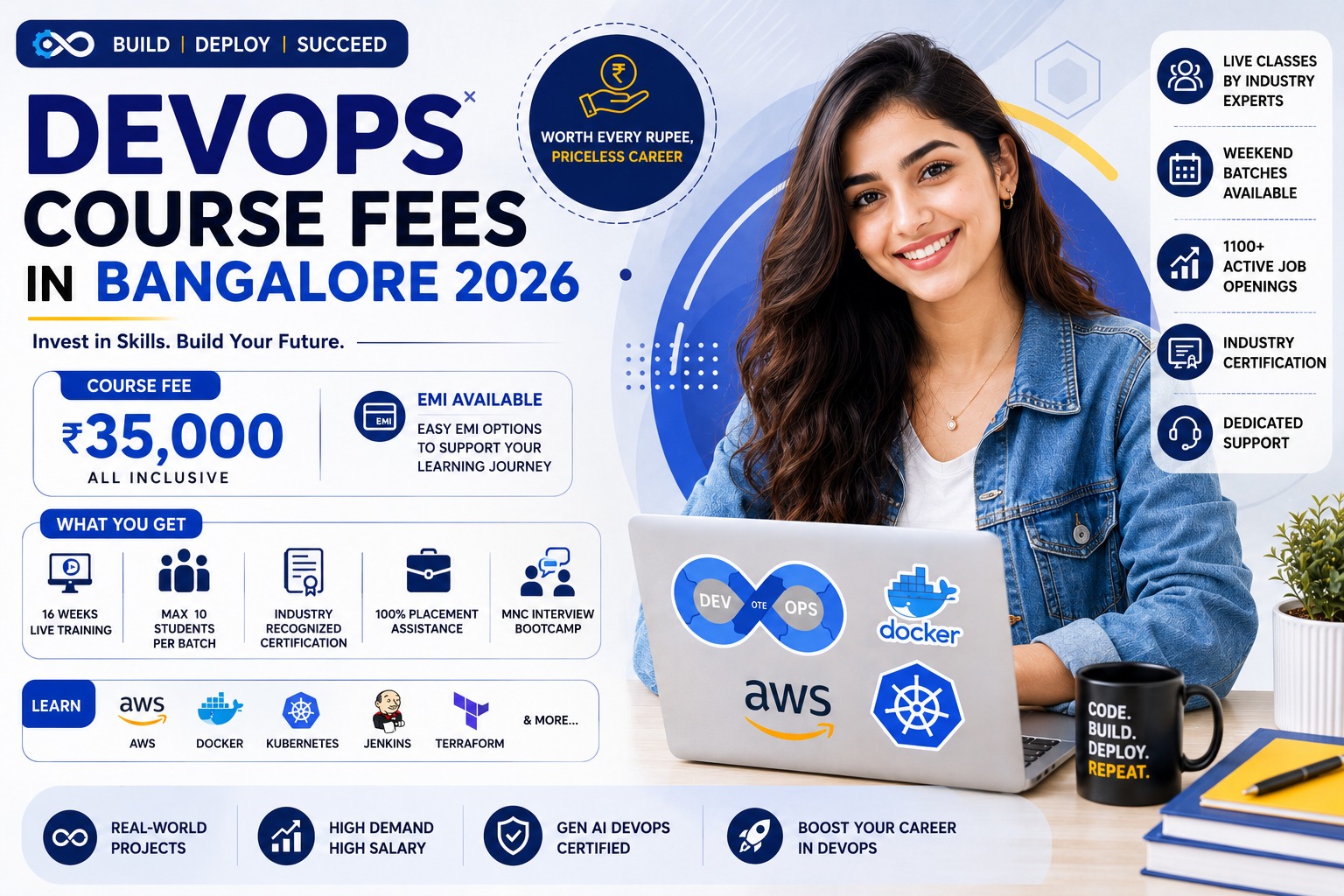
When someone asks me how much a DevOps course costs in Bangalore, I genuinely don't know where to start. I've seen figures quoted from ₹15,000 to ₹2,62,550 — and both are technically accurate, depending on what you're comparing. That range is wider than the salary gap between a fresher and a principal engineer, which tells you something about how unstructured this market is.
I spent time going through the actual course pages of every major DevOps training institute in Bangalore — not aggregator sites, but the actual fee pages and admission brochures. This post is what I found. I'll break down what each institute charges, what's actually included (and what isn't), and help you figure out what fee range makes sense for your situation.
Quick disclaimer: course fees change with promotional cycles. What I'm listing here reflects pricing available in April–May 2026. Always cross-check on the institute's own website before making a decision.
Quick Summary: DevOps Course Fees in Bangalore 2026
- Budget tier (₹25,000–₹40,000): Shifttotech, Apponix, FITA (Advance batch)
- Mid-range (₹40,000–₹60,000): Besant Technologies, ExcelR, Intellipaat
- Premium (₹70,000+): Learnbay, Simplilearn masters program
- Hidden costs to factor in: External exam fees (₹15,000–₹30,000 per cert), placement fees (some charge after job offer)
- EMI availability: Most institutes offer 0% EMI through Bajaj, Razorpay, or Propelld
DevOps Course Fees Comparison Table — Bangalore 2026
Here's a side-by-side comparison of the major institutes. I've tried to use the most commonly advertised fee, not the heavily discounted promotional price that disappears in a week.
| Institute | Fee Range | Duration | Batch Size | EMI |
|---|---|---|---|---|
| Shifttotech Academy | ₹35,000 | 4 months | Max 10 | ₹3,500/mo |
| FITA Academy | ₹30,000 – ₹60,000 | 2–3 months | Large (30–50) | Available |
| Besant Technologies | ₹40,000 – ₹50,000 | 3 months | Medium | Available |
| Apponix Technologies | ₹25,000 – ₹55,000 | 1–3 months | Medium | Available |
| Intellipaat | ₹60,000 | 3 months | Large | 0% interest |
| Learnbay | ₹80,000 | 10 months | Medium | No-cost EMI |
| ExcelR | ₹45,000 – ₹86,000 | 3–4 months | Large | Available |
* Fee data sourced from official institute websites, April–May 2026. Promotional prices excluded.
What Each Institute Actually Offers at That Price
A table only tells half the story. The other half is what happens when you're actually sitting through the classes, building your projects, and going through mock interviews. Let me walk through each institute honestly.
FITA Academy — ₹30,000 to ₹60,000
FITA is one of the most searched names when someone types "DevOps training Bangalore" and that brand recognition comes from years of consistent marketing. Their classroom centres in Marathahalli and Koramangala are busy, which means you'll be in a batch with 30–50 other people.
That's not necessarily bad — it can be motivating to learn alongside a large cohort. But if you're someone who needs instructor attention when you're stuck on a Kubernetes configuration or a Jenkins pipeline error, large batch sizes make that harder. Their curriculum covers the standard stack (Git, Docker, Jenkins, Ansible, Kubernetes) over roughly 60+ hours. Placement support exists, but it functions more like resume assistance and interview prep than guaranteed job referrals.
The fee variation (₹30,000 to ₹60,000) comes from whether you're taking an online or classroom format, and whether you're enrolling at promotional pricing or standard pricing. Worth calling them directly to ask what's active when you're enrolling.
Besant Technologies — ₹40,000 to ₹50,000
Besant is serious about tools coverage. Their DevOps curriculum includes SonarQube and JFrog Artifactory alongside the usual Docker and Kubernetes stack — which is actually valuable, since code quality and artifact management are real parts of enterprise DevOps pipelines that many training programs skip. The 12-week program also includes what they call a "3-month placement assurance," though the specifics of what that assurance covers are worth clarifying before you enroll.
They've occasionally run bundle deals — three courses for ₹24,999 — which sounds attractive but read the fine print on what those three courses include and whether you'll actually complete all three while working or studying.
Apponix Technologies — ₹25,000 to ₹55,000
Apponix is worth knowing about if you're looking at the Bangalore-specific training market. They have a "Guaranteed Interview Program" — they commit to arranging a minimum of 10 confirmed interview calls within 90 days of course completion. That's a more specific commitment than the vague "placement assistance" that most institutes offer. The ₹25,000 entry point is for a 2-month DevOps + AWS combo, which at that price is one of the better deals in the market if you're already somewhat technical.
The ₹45,000–₹55,000 range covers a more comprehensive 12-week program. One thing to verify: Apponix's course pages note that external certification exam fees are not included. So factor those costs separately.
Intellipaat — around ₹60,000
Intellipaat sits in the middle-to-upper end at around ₹60,000 for their 12-week program. Their strength is brand recognition — they've been around long enough that hiring managers recognise the Intellipaat certificate name. The course covers the expected DevOps stack, and they have 0% financing available through partner companies.
Where Intellipaat has received mixed feedback is in mentor responsiveness — for self-paced learners who need to ask questions on their own schedule, the support quality can be inconsistent. If you're disciplined and self-directed, the content is solid. If you need hand-holding through complex topics, you might find the experience frustrating.
Learnbay — ₹80,000 (Premium, 10-Month Program)
Learnbay is at the premium end for a specific reason: this is a 10-month, 300+ hour instructor-led program that includes IBM and Microsoft certificates upon completion. If you want the most thorough preparation and have the time to commit to a near-year-long learning journey, this makes sense. The no-cost EMI option spreads the cost reasonably.
The question to ask yourself is whether you actually need 10 months to become job-ready in DevOps, or whether 3–4 months of focused training will get you there. For most people transitioning from IT support, software development, or cloud admin backgrounds, 3–4 months of rigorous training is enough to become interview-ready. For complete career changers with no IT background, a longer program like Learnbay might actually be the right call.
Shifttotech Academy — ₹35,000 (What We Offer and Why)
I should be upfront: we run Shifttotech Academy's DevOps program and we charge ₹35,000. So take what I say here with appropriate skepticism, and compare it against what you've read about the others above.
The single thing we've deliberately built differently is batch size. We cap every batch at 10 students. That's a hard limit — not a guideline. When a batch fills up, we open the next one. This means when you're stuck on a Docker networking issue at 8pm during a weekend session, the instructor actually has time to look at your specific configuration, not just give you a generic answer.
Our 4-month curriculum covers AWS (EC2, S3, VPC, IAM, EKS), Docker, Kubernetes, Jenkins, Terraform, Ansible, Prometheus, and Grafana. Weekend live batches are the default format — weekday batches available on request. We offer 100% job assistance, which means we'll actively refer you to companies we have relationships with, help with resume building, and run mock interviews. For EMI, we have a ₹3,500/month plan over 10 months through our partners.
Our students have joined TCS, Infosys, Wipro, and several Bangalore-based product companies at ₹6–18 LPA. If you want to know more before enrolling, the course page for Bangalore has the full curriculum and our upcoming batch dates.
The Hidden Costs Nobody Advertises
The course fee you see advertised is almost never the total cost. Here are the extras that catch people off guard:
External certification exams. The AWS Solutions Architect Associate exam costs around ₹15,000–₹20,000 and is not included in any institute's standard course fee. The Certified Kubernetes Administrator (CKA) exam costs around ₹30,000. If you're planning to sit these exams — which is a good idea — budget separately. When an institute says "includes AWS certification preparation," that means they prepare you to pass the exam. It doesn't mean they pay for the exam voucher.
Post-placement fees. Some institutes charge a deferred fee payable after you land a job. Always read those terms carefully before enrolling — it is money you owe after you have already started working, and the terms vary significantly between providers.
Lab and cloud costs. Some programs require you to run AWS or GCP instances for practice. Depending on usage, you could spend ₹500–₹3,000/month on cloud bills during training. Good programs either provide credits or structure the labs to use free-tier resources.
Study materials. A handful of institutes charge separately for recorded session access after your batch ends, or for PDF study materials. Always ask upfront: "If I miss a live class, can I watch the recording for free? For how long?"
What to Actually Look At When Comparing DevOps Courses
Fees are the starting point, not the decision. Here's what I'd evaluate if I were choosing a DevOps course in Bangalore right now:
Instructor background. Is the trainer someone who has worked as a DevOps engineer at an actual company, or are they primarily a trainer? There's a meaningful difference. Someone who's managed production Kubernetes clusters for a mid-sized product company can tell you what breaks at 2am and why — that kind of context doesn't come from textbooks.
Batch size and live interaction. Ask specifically: how many students per batch? What's the format — live instructor or pre-recorded? Can you ask questions in real time? The answer to these questions matters more than whether the fee is ₹35,000 or ₹50,000.
Project work. A good DevOps course should have you building end-to-end CI/CD pipelines, deploying containerized applications to Kubernetes, writing Terraform code for real cloud infrastructure, and setting up monitoring with Prometheus and Grafana. If the projects sound like fill-in-the-blanks exercises rather than independent builds, that's a concern.
Placement specifics. "100% placement assistance" is not a commitment. Ask: how many students from your last three batches got placed? In how many weeks? At what salary ranges? Can you connect me with two or three alumni? Institutes that have genuine placement records will answer these questions without hesitation.
Curriculum recency. DevOps is not a static field. Argo CD, GitOps practices, Helm charts, and EKS-managed node groups are real things you'll encounter in Bangalore's job market in 2026. If an institute is still teaching a curriculum built around Jenkins and bare-metal Ansible without touching Kubernetes or cloud-native tools, that's a problem regardless of the fee.
Who Should Spend What: A Practical Guide
If you're a software developer, system administrator, or cloud support engineer looking to transition into DevOps, a 3–4 month program in the ₹25,000–₹45,000 range is typically enough to become interview-ready. You're adding tools and practices on top of an existing technical foundation. You don't need 10 months.
If you're a complete non-technical career changer — coming from sales, HR, finance, or operations — a more expensive, longer program (₹60,000–₹80,000, 6–10 months) might actually save you money in the long run. The slower pace and additional hand-holding can be the difference between successfully transitioning and dropping out halfway through a shorter program.
If you're already working in IT and doing this on evenings and weekends, check whether the institute offers weekend batch options. Most do, but the schedule specifics vary. A weekday-only program with recorded catch-ups is workable but harder to stick with when life gets busy.
For anyone targeting Bangalore-specific DevOps jobs at startups and product companies, our DevOps course in Bangalore page has details on what the local job market actually requires, not just what the course syllabus says.
The ROI Question: How Quickly Does a DevOps Course Pay For Itself?
An entry-level DevOps role in Bangalore pays roughly ₹6.5–₹9 LPA. That's ₹54,000–₹75,000 per month. If you're currently at ₹4–₹5 LPA in an IT support or junior developer role, transitioning to DevOps adds ₹15,000–₹25,000 to your monthly take-home. At that math, even an ₹80,000 course pays for itself within 3–5 months of your first DevOps job. The question is never really whether the course is worth it — it's whether you'll actually complete it and apply consistently for jobs afterward. Read more about DevOps career opportunities in Bangalore and what salaries look like across experience levels.
Frequently Asked Questions
What is the average DevOps course fee in Bangalore?
DevOps course fees in Bangalore range from ₹25,000 to ₹80,000 depending on the institute, duration, and format. Budget-friendly options (₹25,000–₹40,000) include Shifttotech Academy and Apponix. Mid-range (₹40,000–₹60,000) covers Besant and Intellipaat. Premium programs (₹70,000–₹80,000) include Learnbay's 10-month comprehensive bootcamp.
Do DevOps course fees include certification exam costs?
Almost never. External certification exams — AWS Solutions Architect (₹15,000–₹20,000), CKA/Kubernetes (₹30,000) — are paid separately. Course fees typically include only the institute's own completion certificate. Always ask: 'Does your fee include the external exam voucher?' before enrolling.
Is EMI available for DevOps courses in Bangalore?
Yes — most institutes now offer 0% EMI through Bajaj Finserv, Razorpay, or Propelld. Shifttotech Academy offers ₹3,500/month over 10 months. Intellipaat offers 0% interest financing. Learnbay provides no-cost EMI for their ₹80,000 program.
Which institute offers the best DevOps course for freshers in Bangalore?
For freshers with some IT background, Shifttotech Academy (₹35,000, small batch of 10, live instructor) or Apponix (₹25,000–₹45,000, guaranteed interview program) offer good value. Freshers with zero IT background may benefit from Learnbay's longer program for more structured support.
How long does a DevOps course take in Bangalore?
Standard programs run 2–4 months. Accelerated boot camps can compress this to 4–6 weeks. Premium comprehensive programs (Learnbay) run up to 10 months. Weekend-only batches at the same content depth take roughly twice as long as weekday programs.
Will a cheaper DevOps course get me a job in Bangalore?
The course fee itself has no bearing on whether you'll get placed. What matters is the curriculum quality, project work, instructor experience, and your own effort during and after the course. Plenty of people who paid ₹25,000–₹35,000 for a well-structured program have joined Bangalore's product companies at ₹10–₹18 LPA.
See the Shifttotech Curriculum and Batch Dates
Our next batch starts soon — 10 seats maximum, live weekend sessions, 100% job assistance.
Bottom Line
DevOps course fees in Bangalore have a lot of variance, but the variance does not neatly correlate with quality. Some of the most expensive programs are expensive because of marketing and brand premiums, not necessarily better outcomes. Some of the more affordable programs punch above their weight because of small batches and instructors who stay close to what's actually being hired for in the market.
Before you pay anyone — including us — ask the hard questions. What's the batch size? Can I speak to alumni? What companies have your students joined in the last 6 months? What does placement assistance actually mean in practice? The institutes that give you straight answers to those questions are worth trusting with your money and your next 3–4 months.
If you're specifically targeting Bangalore's job market — the startups in Koramangala and HSR Layout, the MNCs in Whitefield and Electronic City, the mid-size product companies across Marathahalli — our full DevOps curriculum is built around what those employers actually ask in their technical rounds. Have questions before committing? Reach us directly — no enrollment pressure, just an honest conversation about whether our program fits where you're headed.