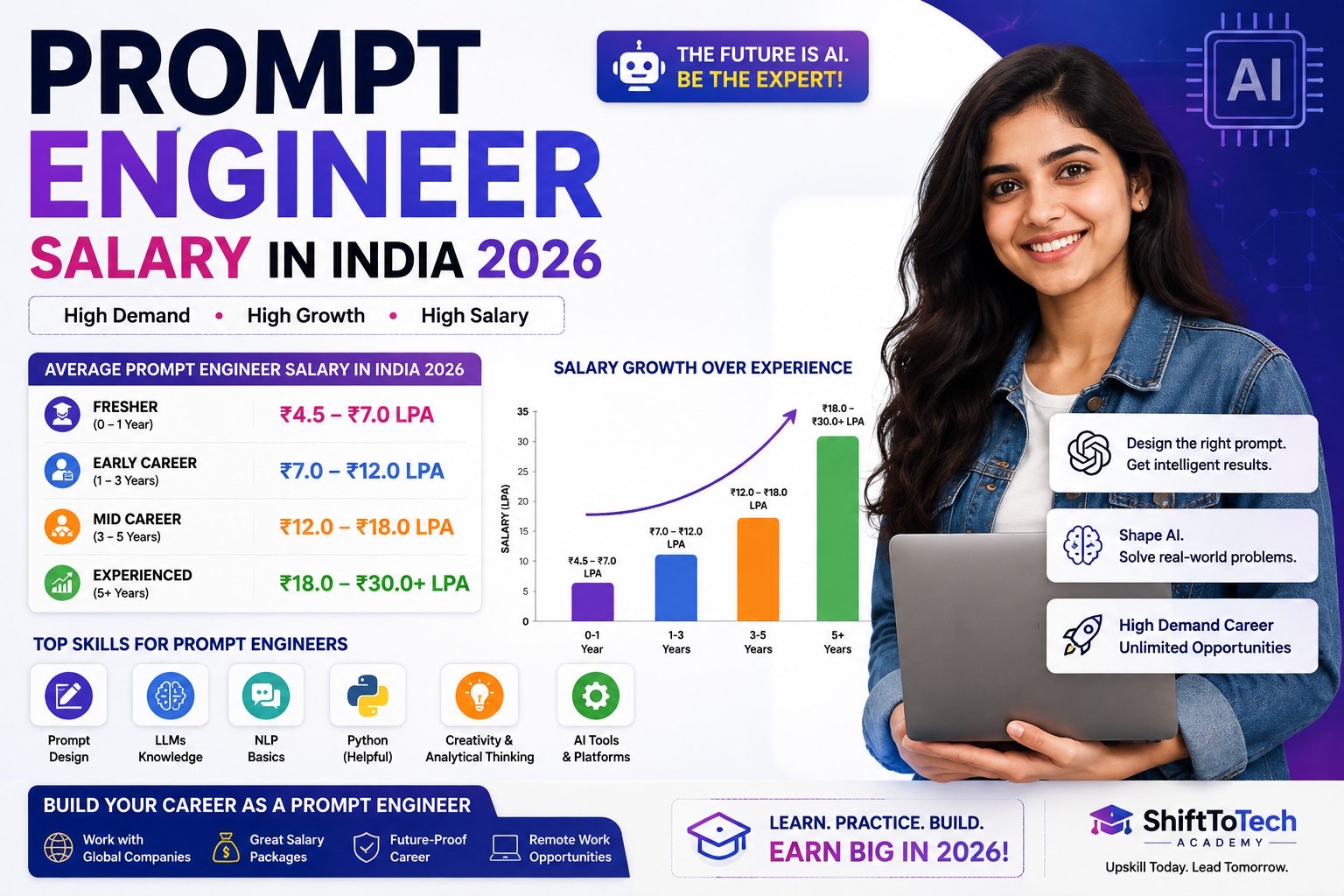
ShiftToTech sells an AI course. Weigh the closing recommendation accordingly.
00 The Two Headlines
In 2023 you could find headlines about prompt engineers earning three crore rupees. By 2025 you could find articles announcing the death of the role entirely. Both were reported as fact, in serious publications, roughly eighteen months apart.
If you're trying to work out what this job actually pays, that gap is where you're stuck. So let's go at it properly.
01 The Short Answer
Roles advertised specifically as "prompt engineer" in India broadly sit in the same band as adjacent AI positions, which is somewhere around ₹6 to ₹20 lakh depending on your experience and the type of company hiring. That's the number, and you can stop reading if it's all you needed.
But I'd rather you didn't stop, because that number comes with a caveat large enough to change what you do with it.
Two people can be told "₹12 lakh" and walk away with completely different pictures. One hears a floor and starts negotiating. The other hears a ceiling and gives up on the field. Neither reading is wrong given only the number, which is a decent sign the number on its own isn't doing much work.
The title itself is being retired. That range describes a shrinking sample of postings, and anyone quoting a confident average is measuring something that's disappearing while they measure it.
02 What the Numbers Actually Say
Start with the headlines, because they're what most people half-remember.
The ₹1–3 crore figures that circulated in 2023 were real, in the narrow sense that somebody was genuinely paid that. They came from a handful of roles at American frontier AI labs, reported without much context about what those jobs involved, or how few of them existed. Anthropic advertised a prompt engineer role in the region of $175,000 to $335,000, and that single posting generated a remarkable amount of Indian coverage — enough that people were still citing it in 2025 conversations about whether to switch careers.
Worth noticing what got lost in the retelling. That job description involved building tooling, running evaluations, and working directly with researchers. It was a senior engineering role at a frontier lab that happened to have "prompt" in the title. It was not, in any useful sense, a job for somebody whose qualification was being good at talking to ChatGPT.
Why any average is unreliable now
When a job title is contracting, the postings that remain are a biased sample. Companies still advertising for "prompt engineer" specifically in 2026 are disproportionately either behind on their own naming conventions, or hiring for something quite narrow. Job-board data also lags reality by several months, because it reflects what was posted rather than what was filled. So you get numbers that look authoritative and describe a market that has already moved.
There's a third problem, and it's the one that trips up people comparing offers. Indian salary aggregators pool self-reported data, and self-reporting on a title this contested is unusually messy. Somebody working as an AI engineer who thinks of themselves as a prompt engineer reports one thing. Somebody with the title on paper doing mostly data annotation reports another. The spread you see on those sites isn't measurement noise. It's two or three genuinely different jobs sharing a label.
Which is why the sensible move, if you're evaluating an actual offer, is to ignore the title entirely and read the job description. What does the day look like? Is there retrieval in it? Deployment? Anything on call? Those answers place the role in a real band far more reliably than the words at the top of the posting.
For the wider picture, which is genuinely more useful than anything specific to this title, our breakdown of the durable AI salary picture in India covers the roles that are actually growing, with bands by experience and company type.
03 Why the Title Contracted
Here's the part that most salary pages leave out, and it's the thing that explains everything else.
The standalone "prompt engineer" job title has been shrinking since roughly mid-2024. Job-board trackers put the decline in postings using that exact title at somewhere around 30 to 40 percent from its peak, and the direction of travel has been consistent enough that it's no longer a debated point. IEEE Spectrum published a piece titled "AI Prompt Engineering Is Dead" in early 2024, which felt premature at the time. Fast Company described the standalone role as more or less gone by 2025.
I'd treat "dead" as overstated even now. But "absorbed" is fair, and here's why it happened.
A great deal of early prompt engineering was compensating for models that took instructions too literally, or lost the thread halfway through. Newer models need less of that scaffolding, and reasoning models need less again.
Prompt management, versioning, evaluation harnesses and structured output enforcement all became things you configure rather than things you hand-craft each time.
Somebody who only writes prompts is idle a lot of the week. The work is real, but it isn't forty hours of work, and it sits naturally next to retrieval, evaluation and deployment. All things somebody has to do anyway.
Prompting sits between engineering and product. The person who best understands what a good output looks like is often the domain expert; the person who has to make it reliable in production is the engineer. A dedicated prompt engineer ends up as a translation layer between two teams who could talk to each other directly.
Worth saying that none of this happened because the 2023 enthusiasm was stupid. At the time, models genuinely were harder to steer, tooling genuinely didn't exist, and the person on your team who'd figured out how to get consistent output from GPT-4 genuinely was doing something nobody else could. The role made sense. Then the conditions that made it make sense changed, over about eighteen months, which is fast enough that a lot of career advice never caught up.
04 Where the Money Went Instead
The work didn't vanish. It moved, and the compensation moved with it.
Consider somebody doing genuinely skilled prompting work in 2024 — designing the instruction layer for a customer support system, testing it against real inputs, iterating on failure cases. Same person, same work, in 2026. They're almost certainly employed as an AI engineer now, and they're probably paid more than they were, because the role around the prompting has expanded.
"What does a prompt engineer earn" is edging toward "what does a spreadsheet user earn". The skill is everywhere, it's genuinely valuable, and it isn't what the job is called.
You can see the same pattern by looking at what happened to compensation on either side of the move. The people who repositioned into AI engineer or LLM engineer roles generally saw their numbers go up, because the job got broader and broader jobs pay more. The people who held onto the narrow title saw postings dry up around them, which is a slower and more uncomfortable way to learn the same lesson.
I'd also flag something about company type here, because it does more work than the title ever did. A services company hiring a "prompt engineer" and a product company hiring an "AI engineer" can be advertising for overlapping work at very different pay, and the difference is the company's business model rather than your skill level. That variable is covered properly on the salary pillar and it's worth understanding before you take any number seriously.
The four roles that absorbed it
| Role | What it took from prompt engineering | What else it requires |
|---|---|---|
| AI Engineer | Instruction design, output shaping, iteration on failure cases | Retrieval, tool calling, deployment, evaluation, cost control |
| LLM Engineer | Prompting at the system layer, structured output, guardrails | Fine-tuning, serving, latency and throughput work |
| Applied ML Engineer | Prompting as one modelling technique among several | Classical ML, data pipelines, experiment design |
| AI Product Manager | Prompt design for spec and evaluation criteria | Product judgement, user research, stakeholder work |
AI engineer deserves a bit more detail, since it's where most people reading this should probably be aiming. The job is roughly: take a language model, connect it to a company's actual data and tools, make the result reliable enough to put in front of users, and know whether it's working. Prompting is maybe fifteen percent of that. Retrieval, evaluation and deployment are most of the rest, and they're the parts that are genuinely hard to fake in an interview.
LLM engineer sits adjacent and skews more technical, closer to the model layer. If you want detail on that path specifically, what LLM engineers actually do goes into the shape of it.
The two I'd flag as underrated are applied ML engineer and AI product manager. Both quietly absorbed a lot of prompting work without anyone announcing it, and both are reasonable destinations for somebody with a strong prompting instinct but not a deep engineering background. The PM route in particular gets overlooked by people who assume the only way into AI is through code. If you came to prompting from a non-engineering background, whether marketing, ops, content or domain expertise of any kind, that's the direction where your existing experience is an asset rather than a gap to explain away.
Worth adding that a fair amount of this work now sits inside agents and the systems around them, which is a different set of problems again — and one where prompting matters, but knowing when not to hand control to a model matters more.
05 What Still Pays for Prompting Skill
So far this has read as a decline story. It isn't, and the other half matters.
While the title was shrinking, the skill was doing the opposite. Prompt engineering now appears as a listed competency in a large majority of AI job postings — one job-board analysis put it near 78 percent in early 2026, against under 20 percent two years earlier. Roughly a fourfold increase in how often employers ask for it, over the same window in which they stopped hiring for it as a standalone role.
Both of those things are true at once, and most articles pick one and run with it.
Prompting has become assumed rather than differentiating. Nobody is going to hire you because you're good at it. A meaningful number of people will decline to hire you if you're not.
That's a real shift in what the skill is worth, but it's a shift in kind rather than a fall in value. It moved from being a selling point to being a baseline, which is what happens to every skill that turns out to be genuinely useful. Version control went through the same thing. So did SQL. Nobody advertises for a "version control engineer", and nobody would argue Git stopped mattering.
The one caveat I'd add is that "assumed" doesn't mean "shallow". Employers asking for prompting as a listed competency are increasingly asking about it properly in interviews — how you'd evaluate a prompt, what you'd do when output quality drops after a model update, how you'd stop untrusted user input from overriding your instructions. Those are real questions with real answers, and the people who only ever prompted in a chat window struggle with them.
If you want the underlying mechanics rather than the market picture, what prompt engineering actually is covers the techniques and which of them still earn their place.
06 If You Already Have the Title
This section is for a specific group, and if you're in it you've probably felt this coming.
Some people took the 2023 advice. They have "Prompt Engineer" in a current job title, or on a CV, or on a LinkedIn headline. If that's you, nothing here means you made a bad decision — the advice was widely given by people who believed it, and the skill you built is genuinely valuable. But the packaging needs work.
On a CV, "AI Engineer" or "LLM Engineer" describes the same work in language recruiters are currently searching for. This isn't dishonest if the work matches, and for most people doing this job, it does.
Fill the gaps that make the broader title credible: retrieval over real documents, evaluation you can defend, and something deployed with a URL somebody can open. None of the three takes a year to learn.
Expect the title to become a mild liability in screening within a year or two, if it isn't already. Not fatal, and not a reason to panic. But a recruiter scanning fifty CVs for an AI engineer role is pattern-matching, and "Prompt Engineer" reads as 2023 in a way that gets gently worse each quarter.
I'd rather say that plainly than let you find out from a silent inbox.
One more thing, aimed at anyone currently employed under this title rather than job hunting. The internal version of this repositioning is usually easier than the external one. Your manager already knows what you do; what they may not have thought about is whether the title on your record still describes it. That's a fifteen-minute conversation, it costs nothing, and title changes inside a company are administratively boring in a way that external job hunts are not. Worth doing before the market forces the issue.
07 What to Learn Instead
Short, because this is covered better elsewhere.
The prompting skill you have is the starting point rather than the destination. What turns it into an employable role is the layer around it: retrieval over messy real documents, evaluation you can defend with a set of test cases rather than an opinion, tool calling, and enough deployment ability to get something behind an API without supervision.
Build one thing that runs. A retrieval system over documents you actually have, with a small evaluation set, deployed somewhere public. That single artefact does more in an interview than any title on your CV.
The evaluation set is the part people skip, and it's the part that signals seniority. Twenty or thirty real inputs with the output you'd consider correct for each, in a spreadsheet, run against every version of the system. It takes an afternoon to build and it's the difference between "I think this works" and "here's how I know". Interviewers notice immediately.
And be honest about the timeline. Somebody with a technical background who already prompts well is looking at a few focused months to fill the gaps. Somebody starting from a non-technical role should plan on longer, and should probably learn Python properly before anything else. Neither of those is discouraging. It's just the actual shape of it, and knowing the shape stops people giving up in month three because they expected week six.
If you'd rather learn that with structure and somebody reviewing your work, our live generative AI program covers exactly that stack. It's one route. The list above is free and works if you actually work through it.
08 Frequently Asked Questions
What is the salary of a prompt engineer in India?
Is prompt engineering dead?
Do prompt engineers really earn ₹1 crore?
Prompt engineer vs AI engineer — which pays more?
Can a fresher become a prompt engineer in India?
Is prompt engineering still worth learning?
09 The Short Version
The question wasn't unanswerable. It was malformed.
"Prompt engineer" describes a job title that spent about eighteen months as a distinct thing and then dissolved back into the roles around it. The skill it named is more widely required than it has ever been. Those two facts sit together perfectly well, and most of the confusion comes from articles that report one and ignore the other.
There's a version of this that sounds cynical, and I want to avoid it. This isn't a story about hype and disappointment, or about a fake job that got found out. It's a story about a genuinely useful skill briefly being important enough to warrant its own job title, and then becoming important enough that everybody needed it. The second thing is a better outcome than the first, even though it feels worse if you'd hitched a career plan to the title.
So learn the skill, and aim at a title that isn't shrinking.
Sources referenced: IEEE Spectrum, "AI Prompt Engineering Is Dead" (2024); Fast Company reporting on the standalone role (2025); job-board posting analyses, 2024–2026. Salary figures are indicative ranges and vary with company type, city and demonstrable experience. This is a fast-moving area — check current job-board data rather than taking any single article's word for it, including this one.
The numbers that actually hold up
This page argued that the question was malformed. If you want the durable bands — by role, experience and company type — they're on the AI salary guide. And if you'd rather build the skills that those numbers attach to, the first session of our program is free.
AI salary in India, properly →