How to Choose an AI Training Institute in Bangalore (2026)
How to Choose an AI Training Institute in Bangalore
Fees from ₹15,000 to ₹3 lakh, a dozen institutes calling themselves the best — here is the checklist a friend in the industry would actually walk you through first.

00 Is AI Training in Bangalore Worth It in 2026?
Search "artificial intelligence training in Bangalore" and you get the same wall of noise everyone else gets — a dozen institutes calling themselves the best, fees that range from ₹15,000 to ₹3 lakh for courses that look suspiciously similar on paper, and landing pages built to convert, not to help you think.
This piece is not trying to sell you anything. It is the checklist a friend in the industry would actually walk you through before you swiped your card. (One honest note: Shifttotech runs an AI program in Bangalore built around the same standards laid out here, and we will link to it exactly once — not every other paragraph.)
Short answer — yes, mostly. Bangalore is still one of the busiest hiring markets in the country for AI and ML talent, between the big IT services players, product companies, and a fast-growing GenAI startup scene. The demand side is genuinely solid. Where things fall apart is the assumption a lot of people walk in with: that finishing a course automatically means a job offer shows up.
That gap between "I finished the course" and "I got hired" is almost never about effort. It usually comes down to four things this guide covers in detail — how current the curriculum actually is, how big the batch was, whether the instructor knew what they were talking about, and whether the placement support was real or just a slide in a sales deck.
It also matters who you are walking in. If you already write code for a living — QA, DevOps, backend, whatever — and you are adding AI/ML on top of that, things tend to click faster. If you are starting from zero, it is still doable, but give yourself a longer runway and be even more careful about which program you pick.
01 5 Formats of AI Training You Will Run Into
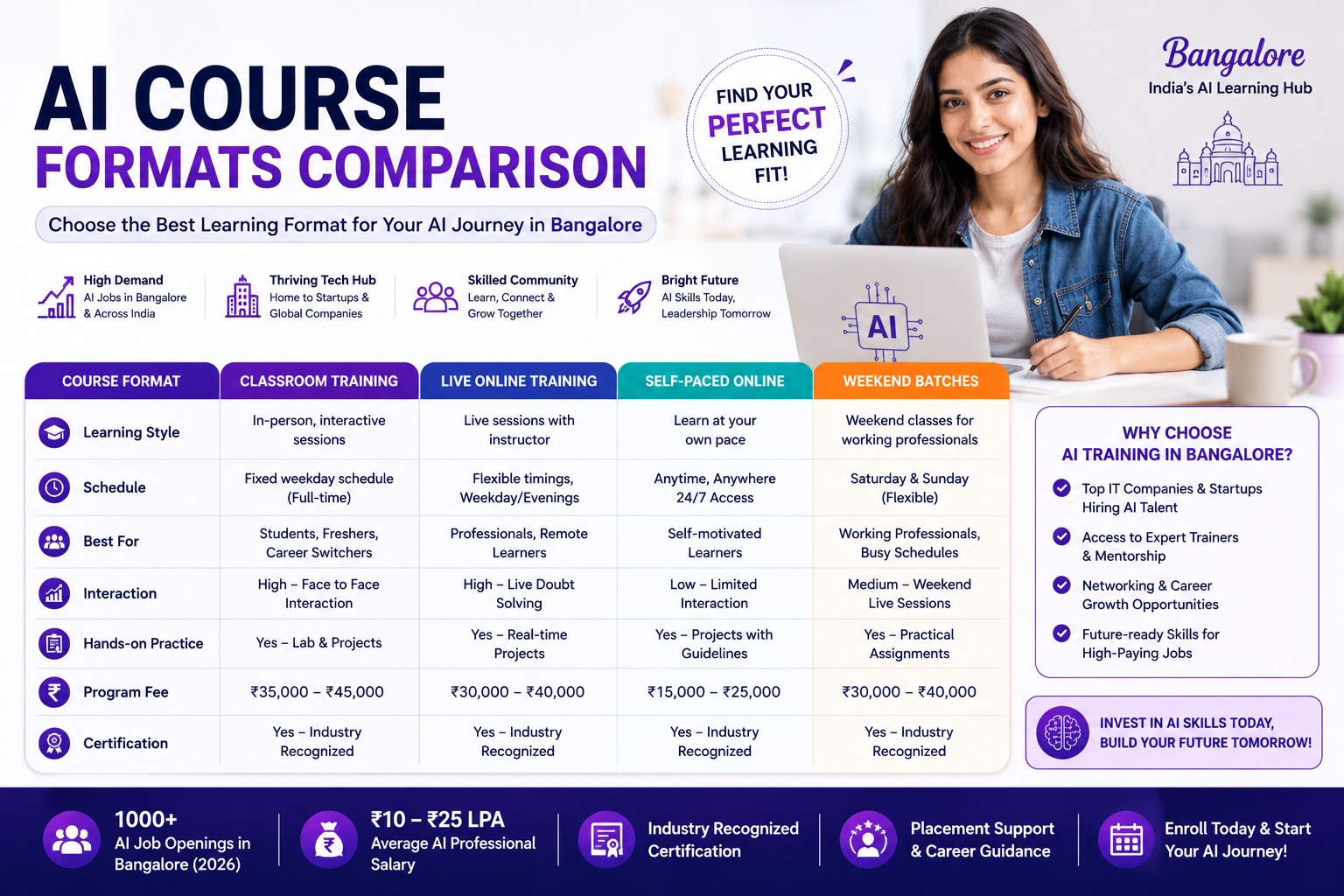
Before you even get to comparing fees, it helps to know what you are actually choosing between, because the format matters almost as much as the institute.
There are large edtech platforms running self-paced video courses to thousands of people at once. There are classroom-style institutes with physical batches. There are bootcamp-style intensives that cram everything into a few brutal weeks. There are university or B-school executive programs, which carry more brand weight but cost more. And then there is small-batch live online — real instructors, real time, smaller groups, no campus to walk into.
| Format | Price Range | Duration | Best For |
|---|---|---|---|
| Large edtech (self-paced) | ₹15,000 – ₹50,000 | 3–6 months | Self-motivated learners on a budget |
| Classroom institute | ₹40,000 – ₹1,20,000 | 3–6 months | Freshers who want in-person structure |
| Bootcamp intensive | ₹60,000 – ₹1,50,000 | 6–16 weeks | Fast career switchers with a coding base |
| University / executive | ₹1,50,000 – ₹3,00,000+ | 6–12 months | Professionals wanting brand credibility |
| Small-batch live online | ₹40,000 – ₹1,00,000 | 4–6 months | Professionals needing flexibility |
If you want the wider picture beyond just Bangalore, we have written a separate guide covering AI courses across India — this one stays focused on the city-specific stuff.
02 Online vs Offline — Which One Fits Your Life
This is not really a "which is better" question. It is a "which trade-off can you live with for the next few months" question.
Offline gives you a local network and someone to physically corner when you do not understand something — which matters a lot if you are a fresher who needs that accountability. But it also means commute, and in Bangalore that is not a small line item. A center on the wrong side of town can quietly cost you two hours a day, on top of the actual class time.
Online removes that problem entirely, which is exactly why it tends to suit working professionals juggling a day job who cannot realistically be at a center for a 7 PM batch. The catch is you need to actually show up for yourself — there is no physical room creating that pull.
03 What You Are Actually Paying For
The fee number on its own tells you almost nothing. What matters is what is bundled into it, and the market here roughly splits into three tiers.
| Price Tier | Typically Included | Often Missing |
|---|---|---|
| ₹15K – ₹40K | Recorded/semi-live content, basic certificate, limited mentor access | Live doubt-clearing, project reviews, placement support |
| ₹40K – ₹1L | Live instruction, smaller batches, some project work, basic placement help | Deep one-on-one mentoring, guaranteed interview volume |
| ₹1L – ₹3L | Brand-name certification, structured placement cell, mentorship, capstones | Sometimes overpriced relative to actual instructor time |
A cheap course is not automatically bad, and an expensive one is not automatically good. A ₹2.5 lakh program packed into a 150-person batch with mostly recorded lectures can give you less real teaching than a ₹50,000 course with ten students and an actual working engineer in the room. The price tells you what you are being charged. It does not tell you what you are getting. For a Bangalore-specific fee breakdown and payback maths, see our guide to AI course fees in Bangalore.
04 Batch Size Matters More Than People Admit
This sounds like a small logistical detail, but it is one of the better predictors of how much you will actually walk away knowing. In a batch of five to ten, an instructor can look at your code, catch the specific thing you are getting wrong, and slow down if half the room is stuck. In a batch of 80 or 200, that is just not physically possible — questions pile up, answers get generic, and project feedback starts feeling templated.
This is not us being precious about it — it is basic teaching mechanics. Shorter feedback loops lead to better learning in technical subjects, and feedback loops get longer the bigger the room gets. So ask about batch size directly, and be a little suspicious if the answer is vague.
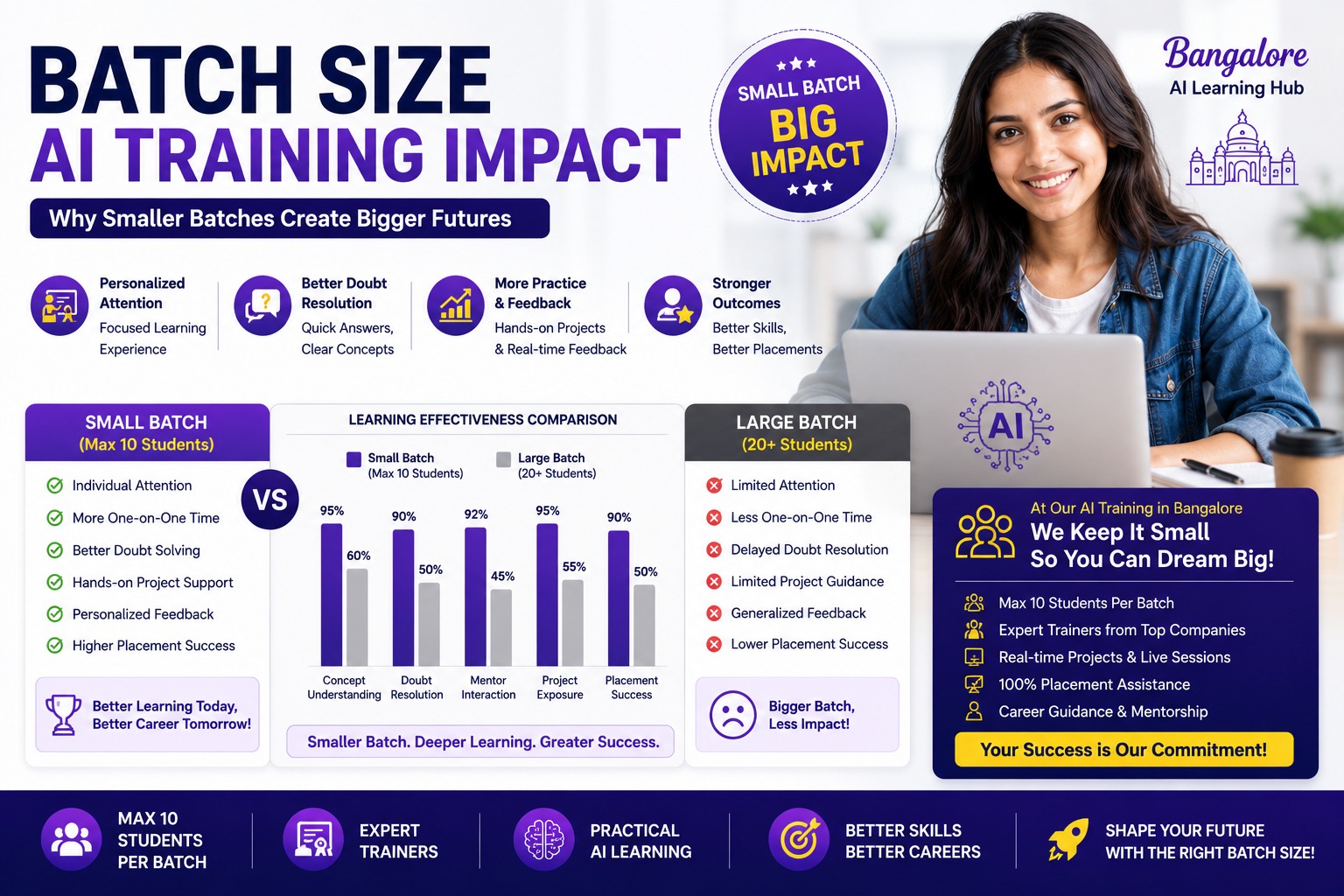
A useful trick during a demo: ask how many students were in the most recently completed batch, not the one being planned. Planned numbers are always rosier. It is also fair to ask whether the person running your demo is the same person who will actually teach the full course.
05 7 Red Flags Worth Checking Before You Enroll
These patterns show up across the board in Bangalore's AI training market — not specific to any one institute, just habits worth checking for. Most take under a minute to verify.
Plenty of "AI training" syllabi are still stuck in 2022 — built around old TensorFlow-style workflows, no real mention of GenAI, RAG, or MLOps. Check: ask to see the current module list, not the brochure version, and when it was last touched.
"100% placement" sounds great until you ask how it is measured — any job, or only AI/ML roles? Over what window? Check: if they cannot answer the methodology, the number means nothing.
A course that ends in quizzes and Jupyter notebooks, with nothing pushed live or to GitHub, leaves you little to show a hiring manager. Check: ask if there is at least one end-to-end deployed project.
"Industry expert" should mean a LinkedIn profile showing real production AI/ML work, not just a history of teaching gigs. Check: it takes two minutes. If the entire visible career is teaching, weigh that.
If an institute will not give you a straight number on batch size before you have paid, that hesitation is itself the answer.
Recorded content with no scheduled Q&A or office hours means whatever you get stuck on stays stuck.
This field moves fast enough that a two-year-old, untouched syllabus is a real problem. If a program cannot tell you when it was last revised, it probably has not been.
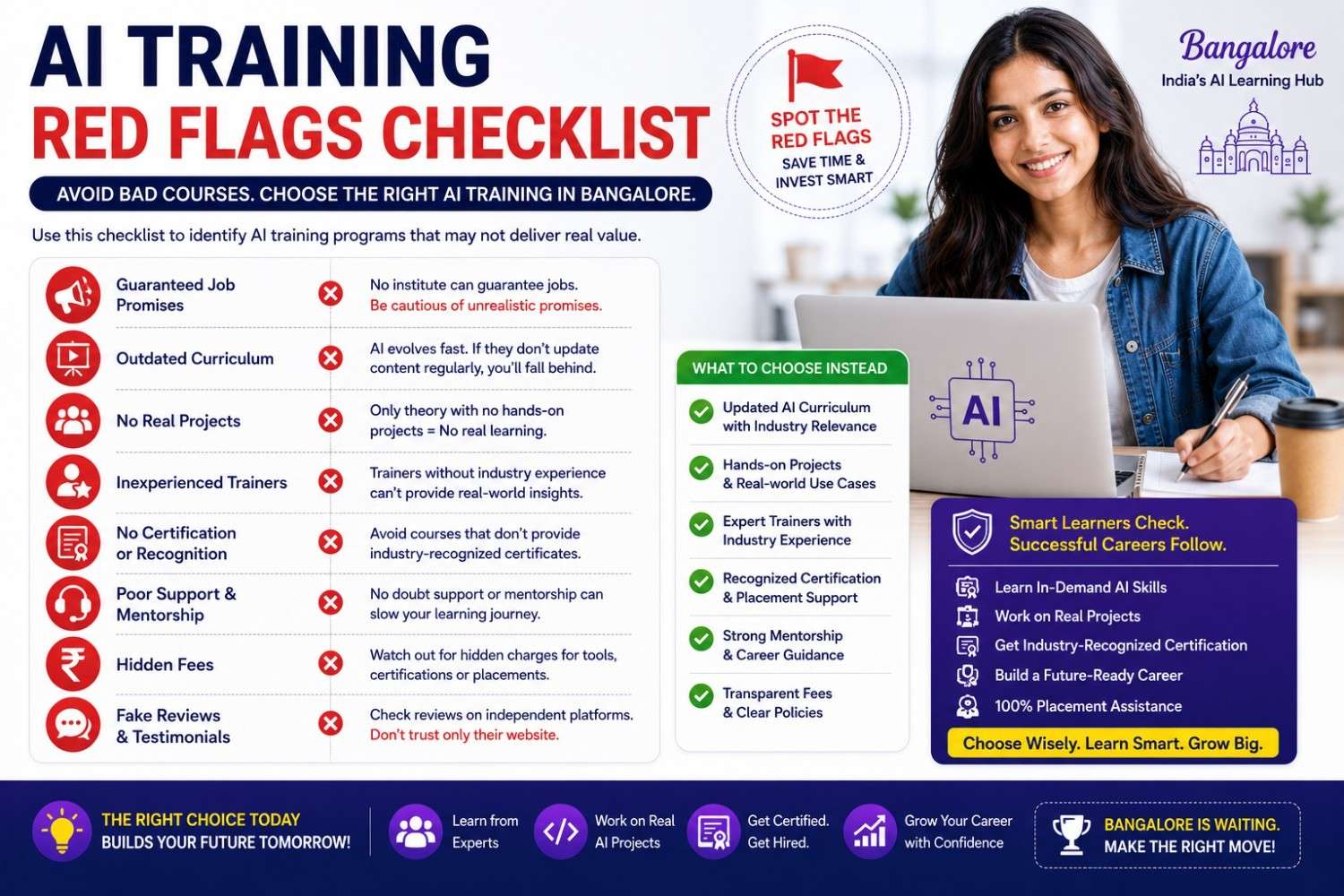
Run through these during a sales call and you will know more in five minutes than most people figure out after paying. If you are curious what employers actually screen for, we have written separately about what a job-ready AI skillset really looks like.
06 5 Questions Worth Asking at Any Demo Class
Most institutes give you a free demo before you commit. Do not just sit through it passively — ask these five and watch how confidently they are answered.
When was the curriculum last updated, and what actually changed in it?
Can you show me LinkedIn profiles of two or three recent students who landed AI/ML roles?
Will I have at least one project that is genuinely deployed, with a public GitHub link, by the time I am done?
What production AI/ML work has the instructor actually done outside of teaching?
Does the course touch ML system design — getting a model from notebook to production — or is it just model training in isolation?
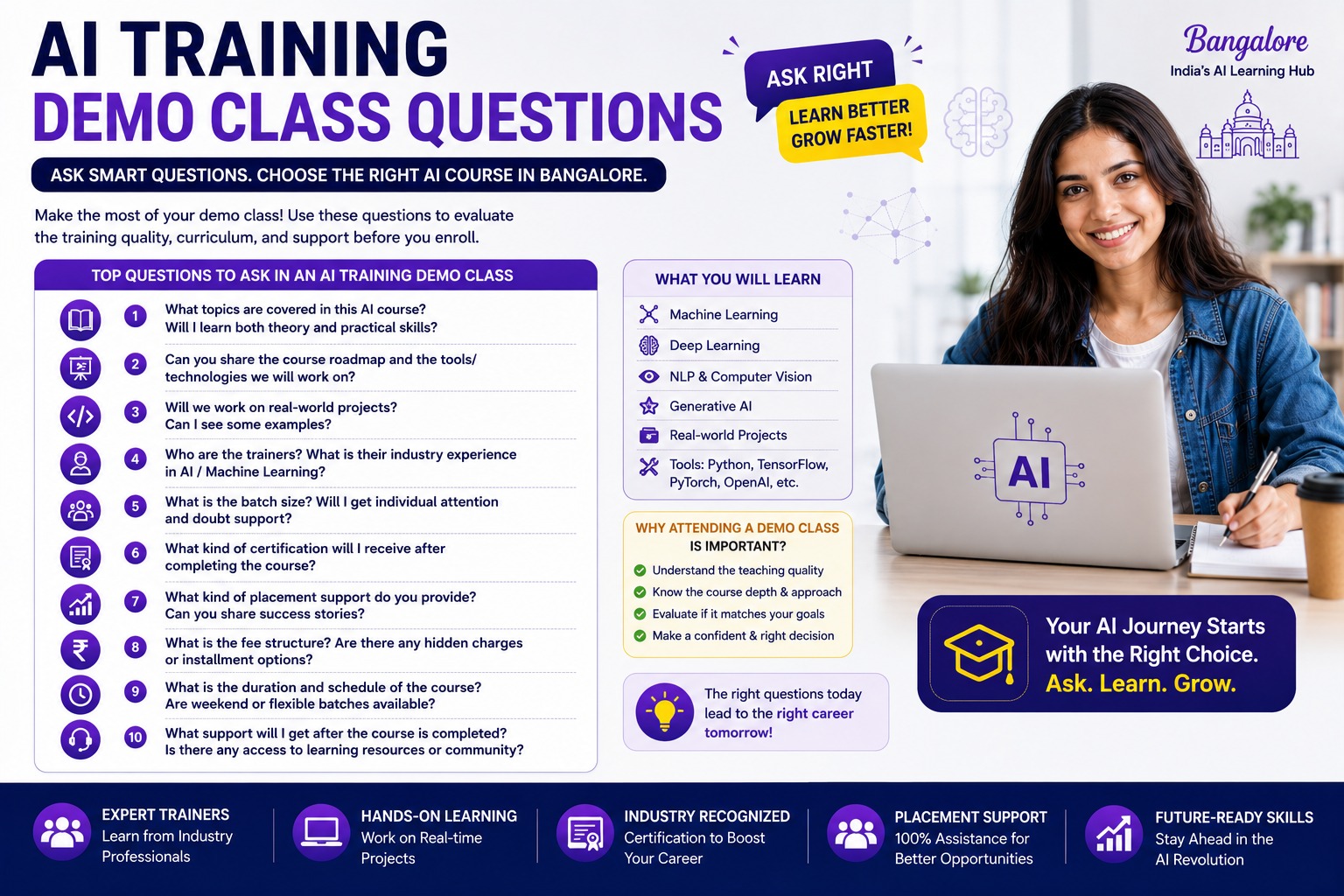
If they fumble more than one of these, that is not bad luck — that is information. A program worth your money usually answers all five without hesitation.
07 What a Good Program Actually Looks Like
Flip the red flags around and you basically get the checklist for a good one:
- ✓ Curriculum updated in the last 6–12 months, covering GenAI, RAG, and MLOps by name
- ✓ Batches small enough that the instructor actually knows your name
- ✓ Placement claims you can check against real alumni, not just a number on a page
- ✓ At least one project you deploy yourself, not just hand in
None of this is unusual or hard to find — it is just what training looks like when an institute optimizes for outcomes instead of enrollment counts. It is the bar we hold our own AI course in Bangalore to, and you are welcome to look at how it is structured if you want a reference point.
Ready to Evaluate AI Training the Right Way?
See the Shifttotech Bangalore AI Program — current curriculum, small batches, real deployed projects, and placement support you can verify.
View Bangalore AI Program →Related reading (Bangalore AI)
- AI Course in Bangalore — full syllabus, fees & placement support
- AI Course Fees in Bangalore — real costs, salary & ROI
- AI Courses Across India — the wider picture
Frequently Asked Questions
Q: Is AI training in Bangalore worth it in 2026?
A: Mostly yes, given how much hiring demand there still is for AI and ML talent in the city. But the actual outcome depends heavily on how current the curriculum is, how big the batch is, and whether placement support is something you can verify rather than just a claim on a page.
Q: Which is the best AI training institute in Bangalore?
A: There is no single universal answer. It depends on your background, your budget, and how you learn best. Run any shortlist through the checklist in this guide (curriculum update date, batch size, verifiable placements, at least one deployed project) before deciding.
Q: How much does AI training cost in Bangalore?
A: Anywhere from ₹15,000 for self-paced platform courses to ₹3 lakh for university-affiliated executive programs. Most live-instructor courses land between ₹40,000 and ₹1,50,000.
Q: Do AI training institutes in Bangalore guarantee placement?
A: Many advertise it, but fewer can explain how the number is actually calculated. Always ask for the methodology (does it count any job or only AI/ML roles, and over what time window) and ask for verifiable alumni you can check on LinkedIn.
Q: Is online AI training as effective as offline in Bangalore?
A: It can be, especially for working professionals who would otherwise lose hours to commuting. The bigger factor is batch size and instructor access, not whether the class is online or offline.
Q: How long does AI training take in Bangalore?
A: Most structured programs run 3 to 6 months. Bootcamps can compress that to 6–16 weeks, and university executive programs can stretch to 9–12 months.
Ready to Start Your AI Career?
Join our comprehensive AI & GenAI course and get job-ready with live projects
Enroll Now - Limited Seats