00 The honest intro
Type "AI automation course" into YouTube or Udemy and you'll drown in the same two messages: "2026 is the year of AI agents — don't lose your job to AI," and "start an AI Automation Agency and make ₹10 lakh a month." Both are half-true, and the half that's missing is the half that matters.
Here's the part nobody leading with hype tells you. AI automation is genuinely one of the most useful skills you can pick up right now — and unusually, one of the fastest, because it's no-code first and project-based. You can build something real in weeks, not the six months a full machine-learning course needs. That part is true.
The part that's oversold: a ₹499 course with forty videos you won't finish doesn't make you billable, and the "agency that runs itself" dream skips the unglamorous reality that clients pay you to solve a specific problem reliably, not to have watched n8n tutorials. This page is the honest version — what AI automation actually is in 2026, what it pays, what a real course should teach, and the mistakes that quietly waste people's time. Including how to judge ours.
01 What "AI automation" actually means in 2026
This is where most people get confused, because the words get used loosely. So, plainly: AI automation is connecting AI models to the apps and data you already use, so that work happens without a human clicking through it — an email arrives, gets understood, gets actioned, and a reply or a record appears, on its own.
The tool at the centre of this in 2026 is n8n — an open-source, visual workflow builder where you wire together triggers, apps, and AI nodes by dragging boxes, not writing a backend. Around it sit Make and Zapier (similar idea), the LLM APIs (ChatGPT, Claude, Gemini) that supply the "intelligence," and agent frameworks for the more advanced builds. You don't need to be a programmer to start — but you do need to understand the concepts, which is exactly where free tutorials leave gaps.
The five terms people mix up — and the course untangles
- Automation — fixed steps, no AI. "When a form is submitted, add a row to a sheet."
- AI automation — a workflow with an AI step inside. "Read this email, classify it, draft a reply."
- AI agent — given a goal, it decides which tools to use and in what order, and can loop and retry.
- RAG — letting the AI answer from your documents instead of guessing, so it stops hallucinating.
- Multi-agent — several agents handing work to each other, like a small automated team.
Knowing which one a problem actually needs — and not over-engineering a three-agent system where one workflow would do — is the judgment that separates someone who "did a course" from someone a client or employer trusts. That judgment is the spine of this course.
02 Why it's the fastest AI skill to become billable in
A traditional AI/ML path asks you to learn Python, the maths, classical models, deep learning, and then deployment — realistically five to six months before you're interview-ready. AI automation is different, and that difference is the whole appeal: because the building blocks are visual and the AI is borrowed via API, you can ship a genuinely useful workflow in your first few weeks.
That has two consequences worth being honest about. The good one: you reach "I built something a business would pay for" far sooner, which is motivating and marketable. The catch: because the barrier is low, the field is noisy — a lot of people have watched the tutorials, so what makes you stand out isn't knowing n8n exists, it's being able to design a reliable automation that handles errors, edge cases, and real messy data. Reliability is the skill. Hype skips it; a good course is built around it.
03 Salary & freelance reality — the honest numbers
Two ways this skill pays: a job (AI automation / workflow roles inside companies) or freelance/agency work (building automations for clients). Here are grounded India ranges, not the outlier screenshots the hype videos use.
| Stage | Path | Typical range | What it takes |
|---|---|---|---|
| Entry (0–1 yr) | AI Automation role | ₹5–8 LPA | A few real, deployed workflows in a portfolio |
| 1–3 yrs | Automation Specialist | ₹9–15 LPA | Agents, RAG, reliability, client/stakeholder sense |
| Senior / lead | AI Architect-leaning | ₹16–30 LPA | Designing systems, not just single workflows |
| Freelance | Per project / retainer | Varies widely | A few proven case studies beats any certificate |
The roles this opens
AI Automation Specialist
AI Agent Developer
Freelance / Agency
The "AI Automation Agency" dream — the honest version
You've seen the pitch: build an agency, automate everything, earn lakhs a month while you sleep. The skill underneath it is real and the freelance market genuinely exists. But here's what the hype videos cut out — clients don't pay for "automations," they pay for a problem reliably solved. Landing and keeping them takes proof (case studies), delivery discipline, and the ability to sit in a discovery call and scope the right solution. That's learnable, and we teach the building and the selling honestly — but anyone promising passive lakhs from a forty-video playlist is selling the dream, not the skill.
04 What the course covers
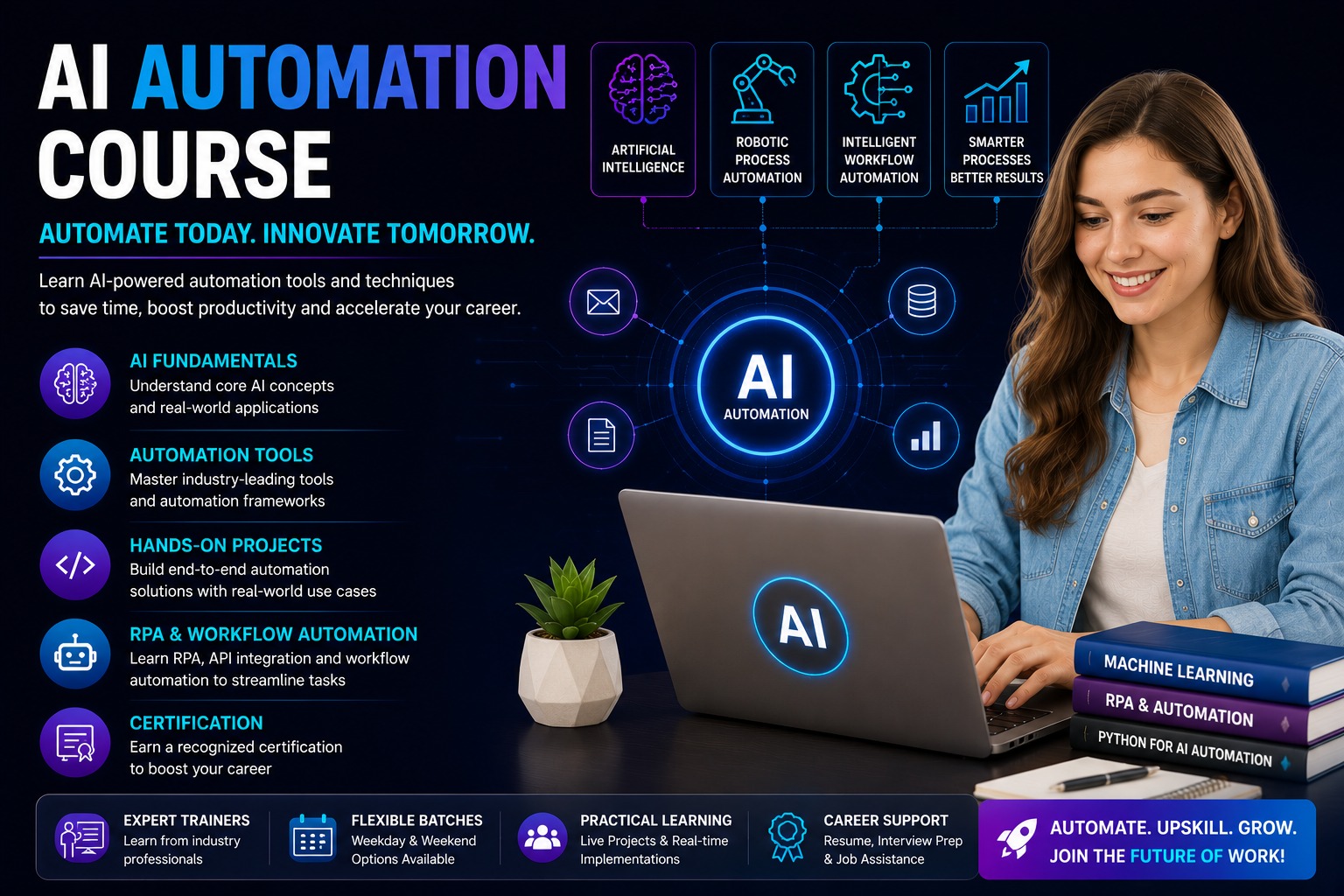
Six phases, taught live and project-first. Every phase ends with something you built and can show — because in this field a working build is worth more than any certificate, to an employer and a client alike.
Automation foundations
The vocabulary most tutorials skip: triggers, actions, APIs, webhooks, JSON, and the crucial distinctions between automation, AI automation, agents, and RAG. Get these right and everything later is easy; skip them and you'll cargo-cult workflows you can't debug.
n8n & real workflows
n8n end to end — nodes, data flow, branching, error handling, and connecting the apps people actually use (Gmail, Sheets, Slack, Telegram, Airtable, Notion). The emphasis is reliability: workflows that don't silently break when the data is messy, which is exactly what separates a portfolio piece from a toy.
Putting LLMs inside workflows
Wiring ChatGPT, Claude, and Gemini into your automations through their APIs — classification, extraction, drafting, summarising — plus prompt engineering as a reliability discipline, not a party trick. You learn to get structured, dependable output a workflow can act on, not a paragraph it can't.
AI agents
The 2026 headline skill: agents that, given a goal, choose which tools to call and in what order. n8n's AI agent node, tool design, memory, and the orchestration patterns behind multi-step and multi-agent builds — taught with a hard eye on when an agent is genuinely the right answer and when it's needless complexity.
RAG & working with real data
Retrieval-augmented generation — embeddings, chunking, vector databases (Pinecone and similar) — so your agents answer from a company's actual knowledge instead of hallucinating. This is the module that turns a demo into something a business will pay for, because grounded answers are the difference between a gimmick and a tool.
Deploy, sell & capstone
Hosting and running n8n reliably (cloud vs self-host), monitoring so you know when something breaks, and a capstone you scope, build, deploy and present. Plus the honest business layer: how to package automations as a service, scope a client problem, and build the case studies that win work — for a job application or a freelance pitch.
05 Who this course is for — and who it isn't
A strong fit if you're:
- A non-developer (marketer, ops, founder, analyst) who wants AI to do real work for you or clients
- A working professional wanting a fast, high-leverage AI skill without a six-month ML commitment
- An aspiring freelancer or solo founder who wants to build and sell automations honestly
- A developer who wants to add agents and workflow automation to your toolkit quickly
Probably not for you if you:
- Want to become a deep ML / model-training engineer — that's our AI/ML course for working professionals, a different path
- Are only after a certificate to list, with no intention of building anything
- Expect a passive-income agency with no client work — that's the dream, not the skill
- Want a purely self-paced video library — a ₹499 Udemy course is a cheaper fit for that
06 Mistakes that quietly waste people's time
Collecting courses. Buying five ₹499 n8n courses and finishing none — confusing "watched tutorials" with "can build reliably."
Build one real thing end to end, badly, then improve it. One deployed workflow teaches more than ten playlists.
Chasing the agency dream before you can deliver. Setting up an "AI Automation Agency" Instagram before you've built anything a client would keep paying for.
Earn proof first — two or three case studies. Clients buy evidence, not enthusiasm.
Over-engineering. Reaching for a three-agent system when a single ten-node workflow would solve it more reliably and cheaply.
Learn to match the tool to the problem — the judgment that actually makes you valuable.
Ignoring reliability. Demos that work once and break on real, messy data the moment a client uses them.
Treat error handling and edge cases as the main event, not an afterthought. That's the billable skill.
07 Fees — and how to read the quotes
The AI-automation market is split in price, and it helps to know why. Self-paced courses (Udemy, Zero To Mastery and similar) run from a few hundred to a few thousand rupees — cheap, and right if you're highly self-disciplined, but with no live help, no feedback, and the completion rates the format is infamous for. Live, structured programmes with real projects and support sit higher, because a tutor watching you build and fixing your broken workflow in the moment is a different product from a video.
We sit in the live band, priced so the skill pays the fee back quickly through a role or a couple of freelance projects. We share the exact current figure, EMI options, and any running discount on a free intro call — and the first session is free, so you can watch a real build and judge the teaching before paying a rupee. One honest filter for any AI automation course you compare: ask what you'll have built and deployed by the end, and whether you keep it. A real course hands you working systems; a video library hands you a completion screen.
08 Frequently asked questions
Do I need coding experience for an AI automation course?
What is AI automation, and how is it different from an AI/ML course?
Will this course actually teach n8n and AI agents, or just theory?
Can I really make money freelancing with AI automation?
How long does it take to become job-ready or client-ready?
Is there a recognised AI automation certification?
Do you offer placement support?
See a real build before you decide
Book a free intro call — meet the trainer, watch a live n8n agent get built, and get a straight answer on whether AI automation fits your goals. No sales script, no hype.
Book your free intro call →