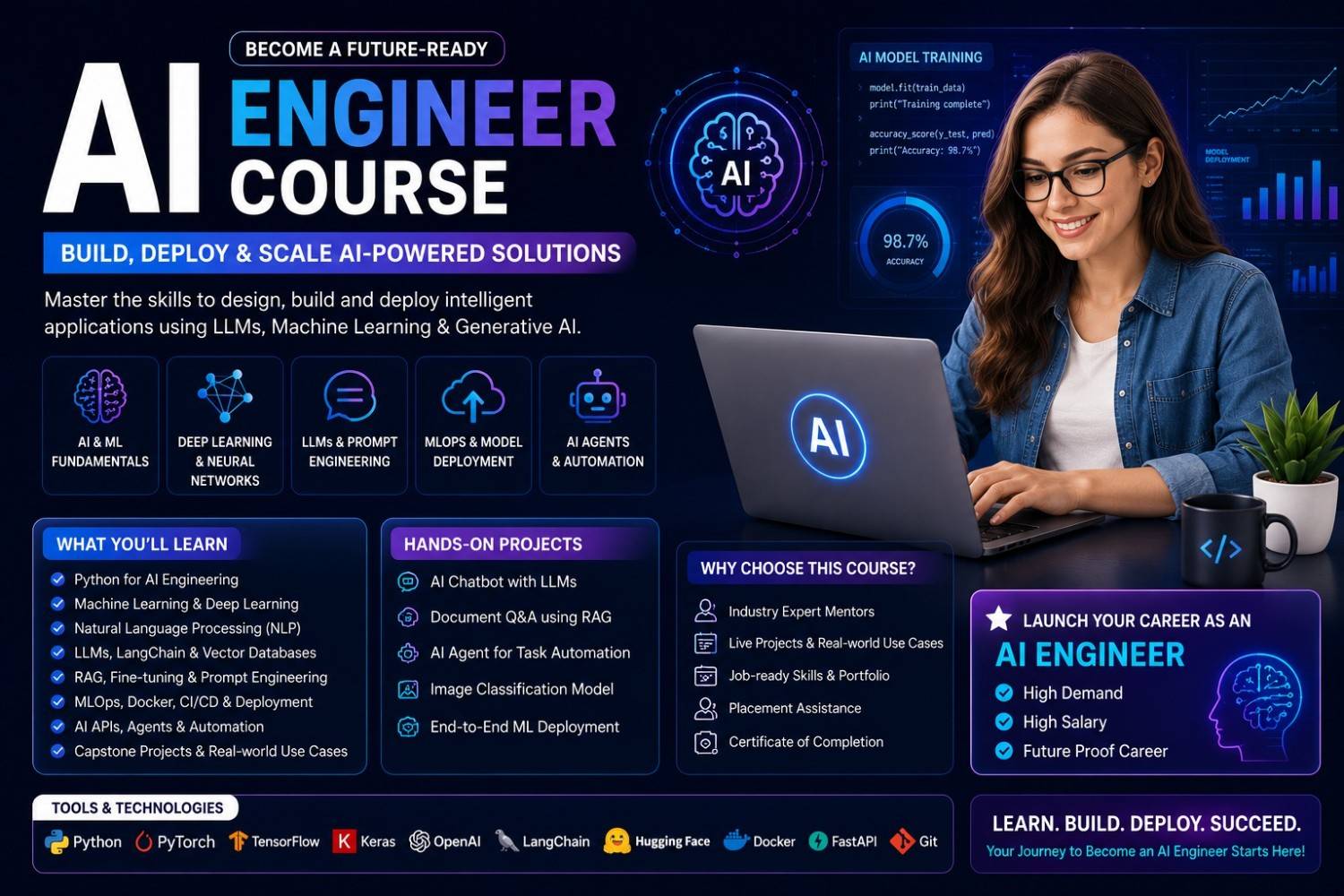
If you searched "AI engineer course," you probably want one thing: the shortest honest path from where you are now to getting hired as an AI Engineer. This page is that path — what the job is, what it pays, what a course should teach in 2026, how the options compare, and how ours is built.
00 Why this page exists
Searches for "AI engineer" have jumped sharply — it is one of the fastest-rising job titles in India, and demand keeps outpacing supply. But the term has quietly changed meaning, and most course pages have not caught up. A lot of "AI Engineer" curricula you will find online are really 2019 machine-learning syllabuses with a Generative-AI module bolted on the end.
The job today is different. The modern AI Engineer spends far less time training models from scratch and far more time building products on top of models that already exist — connecting large language models to real applications, grounding them in a company's own data, adding agents, and making the whole thing reliable enough to ship. That shift is good news if you are switching careers: it leans on software and systems skills more than research-grade maths, which makes the role genuinely reachable.
So this is the honest version. No "become an AI Engineer in 30 days," no promise of a guaranteed ₹40 LPA. Just what the role actually involves in 2026, the salary reality with real numbers, how the well-known courses compare on fees and format, and the roadmap we use to get people there. If our course is the right fit by the end, good; if a different path suits you better, you will at least know why.
01 What an AI Engineer actually does in 2026
Strip away the buzzwords and an AI Engineer is a builder. Given a business problem, they design and ship a system that uses AI to solve it — and most of that system is ordinary software engineering wrapped around a few well-chosen model calls. A realistic week looks less like "invent a neural network" and more like this:
- Wire LLMs into a product — take GPT-class, Claude or Gemini models and build a feature around them through their APIs, with prompts engineered for reliable, structured output a system can act on.
- Build RAG over real data — set up retrieval so the model answers from the company's own documents instead of hallucinating, using embeddings and a vector database.
- Design agents when they fit — give the model tools and memory so it can carry out multi-step tasks, and know when a simple pipeline would be more reliable than an agent.
- Evaluate and guard-rail outputs — measure whether the AI is actually correct, catch failure cases, and add the checks that keep it safe in production. This is the unglamorous skill that separates a demo from a product.
- Fine-tune when it earns its keep — adapt a smaller open model with techniques like LoRA when prompting alone is not enough, without needing a research lab.
- Ship and monitor — expose it as an API, deploy it on the cloud with Docker, and watch it so you know the moment it breaks.
Notice what is not on that list: deriving backpropagation by hand, or training a frontier model from zero. Those belong to research and to large model labs. The AI Engineer role is where the majority of AI hiring actually is — and it is the role this course is built for.
02 AI Engineer vs ML Engineer vs Data Scientist
These three titles get used interchangeably in job ads, which causes a lot of wasted study. Here is the practical difference in 2026:
| Role | Core job | Leans on | On-ramp |
|---|---|---|---|
| AI Engineer | Builds & ships AI-powered products — LLM apps, RAG, agents, deployment | Software + applied LLM work | Fastest |
| ML Engineer | Trains, optimises and serves ML models at scale | ML depth, data pipelines, infra | Medium |
| Data Scientist | Finds insight and builds models to inform decisions | Statistics, analysis, storytelling | Medium |
They overlap at the edges, and plenty of people move between them across a career. But if your goal is to get into AI quickly and you like building things that ship, the AI Engineer lane is the most direct — which is exactly why we target it here. For a deeper side-by-side, including how the day-to-day and salaries differ, read our full guide on AI Engineer vs Data Scientist vs ML Engineer.
03 The skills an AI engineer course must teach in 2026
The fastest way to judge any AI engineer course is to check what it prioritises. A course written for the 2026 job spends most of its time on applied LLM engineering; a dated one spends most of its time on classical theory. Here is the split we teach to — and the things that are commonly over-weighted.
What actually gets you hired
- Confident Python and clean code
- Working with LLM APIs + prompt discipline
- RAG: embeddings, chunking, vector databases
- AI agents: tool use, memory, orchestration
- Evaluation, guardrails & reliability
- Fine-tuning basics (LoRA / PEFT)
- Deployment, APIs (FastAPI), Docker, cloud, MLOps
- Enough ML & deep-learning intuition to debug
Over-weighted for this role
- Months of pure maths before you build anything
- Deriving algorithms by hand from scratch
- Training frontier models from zero
- Kaggle-style competition tuning as the main goal
- Certificates with no shippable project behind them
You still need real maths intuition and real ML — an AI Engineer who cannot reason about why a model is failing is stuck. The point is sequence and weighting: learn the maths you use, in context, and spend the bulk of your time building the LLM-powered systems the job is actually made of.
04 Salary & demand — the honest numbers
AI and ML roles consistently pay well above general software engineering at the same experience — commonly 30–50% more — and AI Engineer is one of the better-paid entry points. But the headline screenshots online are outliers. Here are grounded India ranges for 2026; treat them as indicative, not a promise, because your package depends on your portfolio, your city, and the company.
| Stage | Role | Typical India range | What moves you up the band |
|---|---|---|---|
| Fresher (0–1 yr) | AI Engineer | ₹6–12 LPA | A real portfolio — product companies pay ₹10–15 LPA for strong ones |
| 2–4 yrs | AI Engineer | ₹12–20 LPA | Shipped LLM systems, evaluation, ownership |
| 4–6 yrs | Senior AI Engineer | ₹18–30 LPA | System design, reliability, mentoring |
| Lead / Architect | AI Architect / LLM Lead | ₹30–60 LPA | Owning AI systems end to end, scarce senior supply |
Two premiums are worth knowing: strong Generative-AI and MLOps skills add roughly 20–40% over a generalist at the same level, and the senior end stays under-supplied, which is why architect and LLM-lead pay runs high. For a fuller city-by-city breakdown, see our AI Engineer salary in India guide and the 2026 AI salary overview.
05 The course roadmap — zero to job-ready AI Engineer
Sixteen weeks, taught live on weekends, sequenced so each phase builds something you keep. The order is deliberate: enough foundations to be dangerous, then straight into the LLM-engineering heartland where the jobs are, and finishing on shipping — because a deployed system is what employers want to see.
Python & just-enough maths
Python for AI, clean code habits, and the practical maths you will actually reach for — linear algebra, probability and statistics taught in context, not as a semester of theory. If you have never coded, this is where you catch up; if you have, this is where you tighten up.
Core machine learning
The ML foundations an engineer needs to reason about models: supervised and unsupervised learning, the workflow, and — most importantly — evaluation. Enough scikit-learn to build, and enough judgement to tell when a model is quietly wrong.
Deep learning & the transformer
Neural networks in PyTorch, CNNs and RNNs, and then the one that matters most — the transformer, so you understand how the LLMs you will build on actually work under the hood. Intuition first, so nothing later is a black box.
LLM engineering: prompting, RAG & fine-tuning
The heartland of the modern AI Engineer role. Working with LLM APIs, prompt engineering as a reliability discipline, retrieval-augmented generation with embeddings and vector databases, and fine-tuning a smaller model with LoRA when prompting is not enough.
AI agents & generative systems
Building agents that use tools and memory to complete multi-step tasks — with LangChain, LangGraph and CrewAI — plus the judgement to know when an agent is the right answer and when a plain workflow is more reliable. Evaluation and guardrails throughout.
Ship it: deployment, MLOps & capstone
Turning a project into something real: an API with FastAPI, containerised with Docker, deployed to the cloud, with monitoring so you know when it breaks. You finish with a capstone you scope, build, deploy and present — the centrepiece of your portfolio.
06 How we compare — an honest competitor analysis
"AI engineer course" covers a huge price range, and it helps to see why. The table below sets our program next to the options people most often weigh it against, with real 2026 fees and formats. Numbers for other providers are indicative from their public pages and move over time — check directly before you decide.
| Provider | Format | Fee (2026) | Placement |
|---|---|---|---|
| ShifttoTech — AI Engineer Course | Live online, 16 wks, small batch | ₹35,000 | Support + money-back job guarantee |
| Scaler (AI & ML) | Live cohort, 6–12 months | ₹2–2.8 L | Placement support |
| upGrad × IIT/IIIT (PG in AI/ML) | Online PG, ~12 months | ~₹4.25 L | Placement + degree brand |
| Great Learning / Simplilearn | Bootcamp / blended | ₹70k–₹3.5 L | Career services |
| IBM AI Engineering (Coursera) | Self-paced certificate | ~₹3–4k / month | None (self-study) |
| YouTube / free courses | Self-paced, unstructured | ₹0 | None |
Where we honestly fit
The big-ticket programs are excellent for some people, and the fee is largely brand, cohort scale and marketing — a university or IIT co-brand and a large sales operation cost money that ends up in the price. We deliberately sit at the other end: live teaching in small batches at ₹35,000, growing on student referrals instead of ad spend. The self-paced certificates (IBM's is genuinely good) are cheap but give you no live help, no feedback and the completion rates self-paced video is infamous for.
So the honest positioning: if you want a recognised university credential and can spend ₹2–4 lakh, the big programs make sense. If you are highly self-disciplined and only want knowledge, a ₹0–4k self-paced cert can work. If you want live guidance, small-group feedback, a real deployed portfolio and placement support without the ₹4-lakh price tag, that is exactly the gap this course fills.
07 How to choose an AI engineer course (whoever you pick)
Use this checklist on any course you are comparing, ours included. If a program cannot answer these clearly, that tells you something.
- Is it built for the 2026 job? Look for RAG, agents, evaluation and deployment — not just classical ML with a GenAI afterthought.
- What will you have built and deployed? You should finish with real systems in a portfolio you keep, not a certificate you cannot demonstrate.
- Is it live, or recorded? Live teaching means feedback on your broken code in the moment — a different product from a video library.
- Is the fee transparent? A published price beats "book a call to find out," and watch for placement support charged as a costly extra.
- Is placement described honestly? "Support and referrals" is real; a guaranteed salary figure usually is not. Prefer honesty you can verify — see our take on whether AI course placement guarantees are real or fake.
- Who teaches it? A named instructor with real production experience beats an anonymous "industry expert."
Prefer a step-by-step study plan you can start today for free? Our guide on how to become an AI Engineer lays out the full roadmap with no enrolment required.
08 Who this AI Engineer course is for
A strong fit if you are:
- A software developer or IT professional who wants to move into a higher-paid AI-engineering role
- A fresh graduate aiming to start directly in AI with a portfolio, not just a degree
- A career switcher from any background who is ready to put in real project work
- A working professional who needs weekend classes and cannot quit a job to learn — our AI course for working professionals covers that path too
Probably not the right fit if you:
- Want to become a research scientist inventing new model architectures — that is a deeper, maths-heavy, usually postgraduate route
- Prefer building no-code AI automations and agencies over engineering — see our AI automation course (n8n, LLM APIs, RAG) instead
- Only want a certificate to list, with no intention of building anything
09 Fees
One transparent, published fee for the full 16-week live program — every class, all projects, the capstone, lifetime access to recordings, and placement support included. EMI options available, and the first class is free so you can judge the teaching before paying a rupee. At an entry AI-engineer salary, the fee typically pays itself back within the first couple of months on the job.
Comparing costs across providers first? Our AI course fees in India guide lays out the full ₹0-to-₹4-lakh landscape so you can see exactly where this sits.
10 Frequently asked questions
Is "AI Engineer" a real job, or just a rebranded ML engineer?
Can I become an AI Engineer without a computer science or maths degree?
How long does this course take to make me job-ready?
Do I need to be excellent at maths to become an AI Engineer?
How is this different from your general AI course?
AI Engineer vs ML Engineer — which should I aim for?
What will I have actually built by the end?
Does the course include placement support?
Is ₹35,000 really enough, when other courses cost ₹2–4 lakh?
Become an AI Engineer — starting with a free first class
Sit in on a live session, meet the trainer, see a real LLM system get built, and get a straight answer on whether the AI Engineer path fits your background. No sales script, no hype.
Pre-register for the October 4, 2026 batch