
- New
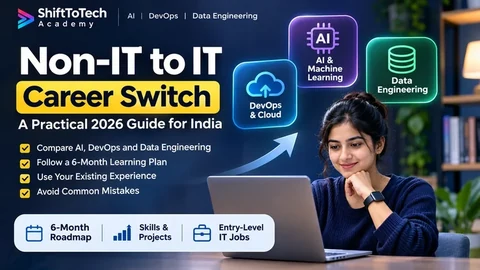
Non-IT to IT Career Switch: A Practical 2026 Guide for India
Switching from a non-IT job to IT? Compare AI, DevOps and Data Engineering for beginners, follow a 6-month plan, and avoid common mistakes. 2026 guide.
Last updated: 12 November 2026
switching from a non-IT job to an IT career is possible in 2026, even if you do not have a computer science degree. The key is to choose the right technical field, learn the required skills and build practical projects that demonstrate your abilities.
For most working professionals, a career transition takes around 6–9 months. This includes learning the fundamentals, completing projects and preparing for job interviews.
This guide is for professionals working in BPO, customer support, sales, accounts, finance, banking, operations, teaching, healthcare administration and non-CS engineering backgrounds.
At ShiftToTech Academy, we help students and working professionals explore careers in AI, DevOps & Cloud and Data Engineering. Let's understand which path may be suitable for your background.
Can a Non-IT Person Get an IT Job in 2026?
Yes. You can enter the IT industry without having a computer science degree. However, employers increasingly look for practical skills, technical knowledge and the ability to solve real-world problems.
A general IT certificate alone may not be enough to secure a job. You need to demonstrate what you can actually do.
Some important factors to consider:
-
Technical skills: Learn the tools and technologies required for your chosen role.
-
Practical projects: Build projects that demonstrate your understanding of real-world applications.
-
Problem-solving: Develop the ability to troubleshoot issues and explain your approach.
-
Interview preparation: Practise technical questions and prepare to discuss your previous experience.
The best approach is to focus on one career path instead of trying to learn multiple technologies simultaneously.
Which IT Career Is Best for Your Non-IT Background?
Your previous work experience can help you choose a suitable IT career. Different professional backgrounds offer different transferable skills.
Here are some examples:
| Your current background | Recommended IT field | Skills to learn first |
|---|---|---|
| BPO and Customer Support | DevOps & Cloud | Linux, Networking, AWS |
| Accounts and Finance | Data Engineering | SQL, Python |
| Banking and MIS Reporting | Data Engineering | SQL, Python, Excel |
| Operations and Supply Chain | Data Engineering or DevOps | SQL, Linux |
| Mechanical, Civil or Electrical Engineering | DevOps or Data Engineering | Linux, Python |
| Healthcare Administration | Data Engineering | SQL |
| Business Analyst | Data Engineering | SQL, Python |
| Manual Testing and QA | Data Engineering or DevOps | Git, SQL, Linux |
| Sales and Marketing | AI | Python basics |
| Teaching and Content | AI | Python basics |
For example, someone working in accounts may find Data Engineering interesting because the role involves working with structured information, databases and reporting.
Similarly, professionals from customer support may find DevOps & Cloud worth exploring because the field involves troubleshooting, monitoring and resolving technical issues.
Not sure which field to choose? Spend a week exploring the fundamentals of two different career paths before committing to a learning programme.
AI vs DevOps & Cloud vs Data Engineering: Which Is Easier for Beginners?
AI, DevOps & Cloud and Data Engineering are three different career paths with growing applications across the technology industry.
However, each field requires a different combination of technical skills.
| Comparison | DevOps & Cloud | Data Engineering | AI & Machine Learning |
|---|---|---|---|
| Main responsibility | Automating software delivery and managing cloud infrastructure | Building and managing data pipelines | Developing intelligent applications and AI models |
| Programming | Basic scripting and Python | SQL and Python | Python and programming fundamentals |
| Important skills | Linux, Docker, AWS, Kubernetes | SQL, Python, Spark, AWS | Python, Machine Learning, Deep Learning |
| Beginner challenge | Linux and Networking | SQL and Data Modelling | Python and Mathematics |
| Entry-level roles | Junior DevOps Engineer, Cloud Support Engineer | Junior Data Engineer, ETL Developer | Junior AI Engineer, AI/ML Associate |
| Suitable for | People interested in systems and troubleshooting | People interested in data and problem-solving | People interested in programming and intelligent applications |
Which Field Should You Choose?
Choose DevOps & Cloud if you enjoy troubleshooting, working with servers, automating tasks and understanding how applications run.
Explore our DevOps & Cloud course to understand the learning path.
Choose Data Engineering if you enjoy working with Excel, databases, structured information and data processing.
Explore our Data Engineering course to understand the skills and technologies involved.
Choose AI & Machine Learning if you are interested in Python, intelligent applications, automation and building AI-powered solutions.
Explore our AI & Machine Learning course to learn more.
There is no single easiest field for everyone. Your interests, learning time and willingness to practise will influence your progress.
A 6-Month Roadmap to Switch from Non-IT to IT
A structured learning plan can make your career transition easier. The following roadmap assumes that you are currently working and can dedicate approximately 8–10 hours every week to learning.
Month 1: Choose Your Career Path and Learn the Basics
Start by understanding the fundamentals of your chosen technical field.
-
Explore two career paths before making a decision.
-
Understand basic computer concepts.
-
Learn how to use the command line.
-
Create a GitHub account.
-
Set up the tools required for your learning.
Month 2: Learn the Core Technical Skills
Focus on the fundamental technologies required for your selected career.
-
DevOps: Linux fundamentals, networking and AWS basics.
-
Data Engineering: SQL fundamentals and Python.
-
AI: Python programming and basic statistics.
Do not rush through this stage. A strong foundation makes advanced topics easier to understand.
Month 3: Start Learning Industry Tools
Once you understand the fundamentals, move towards practical tools.
-
DevOps: Docker, CI/CD and Terraform.
-
Data Engineering: Pandas, AWS S3, AWS Glue and data warehouses.
-
AI: Scikit-learn, machine learning fundamentals and LLM APIs.
Try to understand why each tool is used rather than simply memorising commands.
Month 4: Build Practical Projects
Projects help demonstrate your technical knowledge to potential employers.
Start with two practical projects related to your chosen field.
For example:
-
DevOps: Build and deploy a CI/CD pipeline using Jenkins and Docker.
-
Data Engineering: Create an ETL pipeline using Python and SQL.
-
AI: Develop a basic AI application using Python and an LLM API.
Upload your projects to GitHub and document how they work.
Month 5: Prepare Your Resume and LinkedIn Profile
Your resume should highlight the technical skills you have developed along with your previous professional experience.
Focus on:
-
Adding relevant technical skills.
-
Highlighting practical projects.
-
Creating a professional GitHub portfolio.
-
Updating your LinkedIn profile.
-
Practising technical interview questions.
-
Preparing to explain your career transition.
Your previous experience should not be hidden. Explain how your existing skills can contribute to your new role.
Month 6: Start Applying for IT Jobs
Start applying for relevant entry-level and associate positions.
-
Search for jobs matching your technical skills.
-
Apply to 10–15 relevant positions every week.
-
Connect with recruiters and professionals on LinkedIn.
-
Ask for referrals where possible.
-
Practise mock interviews.
-
Continue improving your projects based on feedback.
Many professionals may need more than six months to secure their first IT position. The important thing is to remain consistent and continue improving your technical skills.
Essential Skills Every Non-IT Professional Should Learn
Regardless of which technical career you choose, some foundational skills are useful across multiple IT roles.
1. Linux Fundamentals
Linux is widely used in cloud infrastructure, DevOps and server administration.
Learn basic commands, file permissions, directory management and shell scripting.
2. SQL
SQL is an important skill for working with databases and structured information.
Understand SELECT statements, filtering, joins, grouping and basic database operations.
3. Python Programming
Python is widely used in automation, AI, Data Engineering and scripting.
Start with variables, loops, functions, lists and dictionaries before moving towards advanced topics.
4. Git and GitHub
Git helps developers track changes in their code. GitHub allows you to store and share your projects.
Learn basic commands, repositories, branches and commits.
5. Cloud Computing
Understand the fundamentals of cloud platforms such as AWS, Microsoft Azure and Google Cloud.
Start with basic concepts such as compute, storage, networking and cloud services.
6. Communication Skills
Technical knowledge is important, but communication also matters.
You should be able to explain your projects, discuss problems and communicate your ideas during interviews.
You do not need to master everything before applying for your first IT job. Start with the fundamentals and gradually develop your technical knowledge.
How to Use Your Previous Work Experience to Get an IT Job
One common mistake career switchers make is treating their previous experience as irrelevant.
Your earlier work experience can demonstrate useful professional skills.
For example:
-
Customer Support: Handling customer complaints, resolving tickets and working within service-level agreements can demonstrate problem-solving and incident-management experience.
-
Accounts and Finance: Working with financial records and reconciliations can demonstrate attention to detail and data-handling skills.
-
Operations: Managing workflows and improving business processes can demonstrate an understanding of process optimisation.
-
Quality Assurance: Testing applications and identifying issues can demonstrate analytical and troubleshooting abilities.
The goal is to connect your previous responsibilities with the requirements of your new technical role.
Common Mistakes to Avoid When Switching from Non-IT to IT
Changing careers requires planning and consistent effort. Avoid these common mistakes:
1. Collecting certificates without building projects
Certificates can help demonstrate your learning, but practical projects provide evidence of your technical abilities.
2. Learning too many technologies together
Trying to learn AI, DevOps and Data Engineering simultaneously can make it difficult to develop expertise. Choose one primary career path first.
3. Ignoring technical fundamentals
Jumping directly into advanced tools without understanding Linux, networking, SQL or Python can create learning difficulties.
4. Expecting a guaranteed job
No training institute can control an employer's hiring decision. Be careful with unrealistic placement and salary promises.
5. Leaving your current job too early
If possible, continue working while learning. Consider switching only when you have developed the required skills and have a realistic career plan.
6. Expecting an immediate salary increase
Your first IT role may offer a salary similar to or lower than your current compensation. Focus on developing practical experience and building your long-term career.
Should You Learn IT Skills Yourself or Join a Professional Course?
Both self-learning and structured training can help you enter the IT industry.
Self-learning is suitable for people who can independently follow a roadmap, practise regularly and solve technical problems.
A professional course may be useful if you need structured classes, practical assignments, trainer guidance and interview preparation.
Before enrolling in any training programme, consider these questions:
-
Are the classes live or pre-recorded?
-
How many students are there in each batch?
-
Will you work on practical projects?
-
Are trainers available to resolve technical doubts?
-
What exactly does placement assistance include?
-
Is there a demo class and a clearly defined refund policy?
Choose a programme based on its learning quality, practical training and transparency rather than marketing promises alone.
How ShiftToTech Helps Non-IT Professionals Start Their IT Journey
ShiftToTech Academy offers live online training programmes in AI & Machine Learning, DevOps & Cloud and Data Engineering.
Our programmes are designed for students, fresh graduates and working professionals who want to develop technical skills and explore opportunities in the IT industry.
Learning from the Fundamentals
Our programmes introduce essential concepts before moving towards advanced tools and technologies.
Live Online Classes
Attend instructor-led sessions and learn through practical demonstrations and guided exercises.
Small Batch Learning
Our batches have a maximum of 10 learners, allowing more opportunities for interaction and doubt clarification.
Practical Projects
Work on projects that help you understand how technologies are used in real-world environments.
Career Preparation
Get support with resume preparation, LinkedIn profile improvement, mock interviews and career guidance.
Transparent Course Information
Understand course fees, programme structure and refund terms before enrolling.
Explore our programmes:
Frequently Asked Questions
Can I switch from non-IT to IT at 30 or 35?
Yes. Employers hiring for DevOps, data and AI roles look at skills and projects more than age. Your earlier experience can count in your favour if you link it to the new role. Expect a junior or associate title at first.
Do I need a computer science degree to get an IT job?
No. Most DevOps, Data Engineering and AI employers care about what you can build. Some large companies still filter by degree, so projects and referrals matter more for switchers.
Which IT field is easiest for non-IT people?
For most non-IT starters, DevOps & Cloud or Data Engineering can be easier starting points because you can begin without heavy programming. AI is also a good choice, but learn Python basics first.
How long does a non-IT to IT career switch take?
Usually 6 to 9 months if you keep your current job: 3 to 4 months of learning, a month of projects, and 2 to 3 months of job search.
Do I need to learn coding?
Some. All three paths use SQL or scripting, and basic Python. DevOps needs the least programming, AI the most.
Will my salary drop if I switch to IT?
It may stay the same or dip slightly in the first role. With the right skills, growth over the following two or three years is usually faster than in most non-IT roles.
Not Sure Which IT Career Path Is Right for You?
Choosing the right career path is an important first step. Your previous experience, interests and learning goals should influence your decision.
At ShiftToTech Academy, you can speak with our team and explore whether AI, DevOps & Cloud or Data Engineering is a suitable starting point.
Book a free demo class and discuss your career goals with our team.
Website: https://shifttotech.co.in/
Call / WhatsApp: +91 79823 70840
Email: [email protected]