
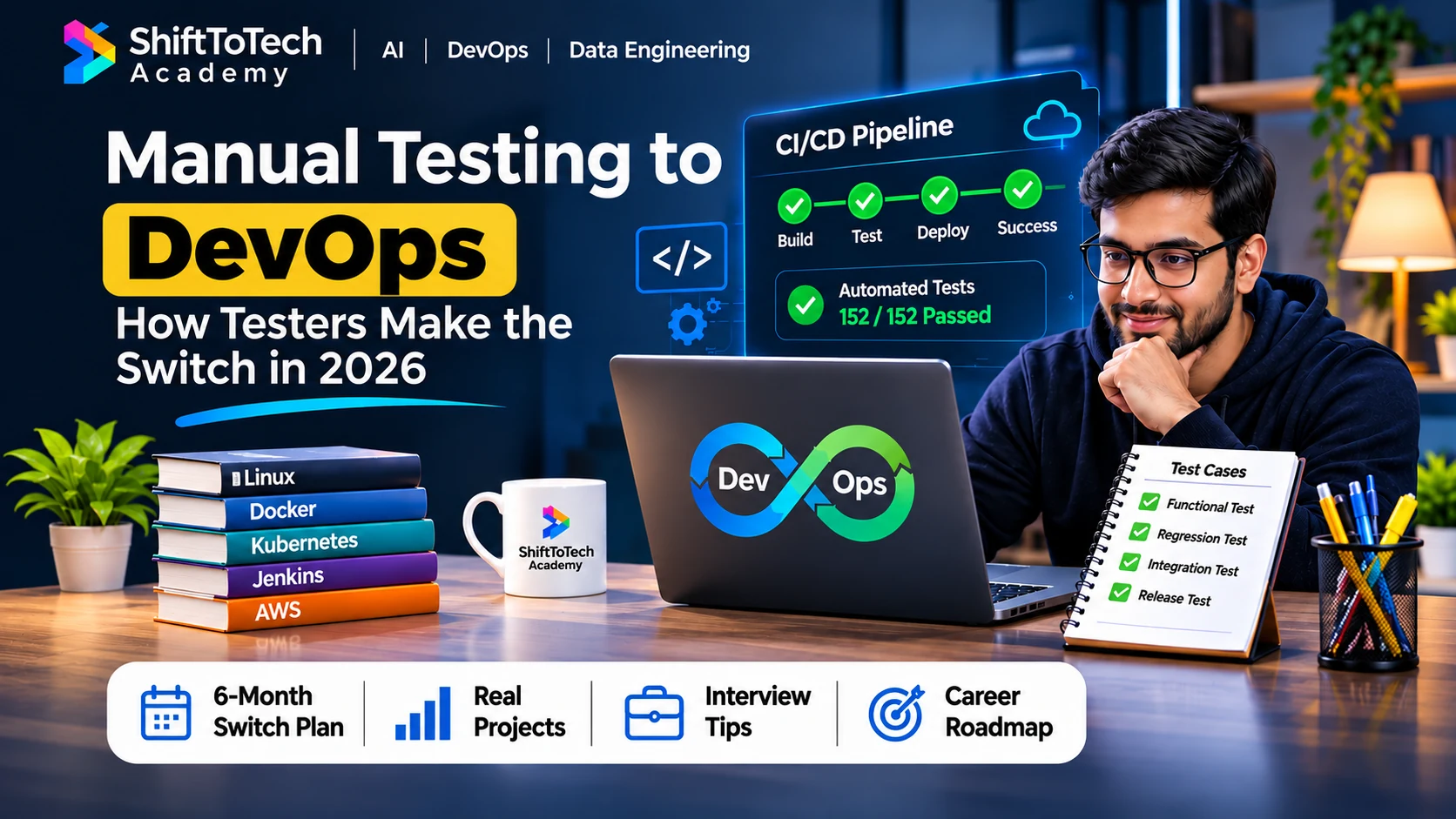
Manual Testing to DevOps: How Testers Make the Switch in 2026
Moving from manual testing to DevOps? See which QA skills carry over, what to learn first, a 6-month plan, project ideas and interview tips for 2026.
Last updated: 14 November 2026
If you have spent a few years writing test cases, logging bugs in JIRA and staying back on release night waiting for a build to reach the QA environment, you have already watched DevOps work from very close. You just haven't been the person running it.
Short answer: yes, a manual tester can become a DevOps engineer, and testers usually make the move faster than people from outside IT. You don't need to become an automation tester first. You do need Linux, basic scripting, one cloud platform and CI/CD, plus two or three projects you can show. If you study around a full-time job, plan on 6 to 9 months.
Can a manual tester really become a DevOps engineer?
Yes. Testers sit exactly where code meets the environment. Think about the bugs you have raised that weren't really bugs in the code: 'works on dev, fails on QA', a missing config value, a build that never got deployed, test data that vanished overnight. Those are DevOps problems, and you have been reporting them for years.
What changes is your side of the table. Today you find the problem and hand it over. In DevOps you write the script, pipeline or configuration that stops it from happening again, and sometimes you are the one called when production goes down.
There is also a practical reason to move now. Fewer teams hire for purely manual testing than a few years ago, and AI tools can already draft basic test cases. Your knowledge of how software fails is still valuable. It just needs to sit on top of skills that are harder to automate away.
What from your testing job carries over
More than most testers expect. Here is how everyday QA work maps to DevOps work:
| What you do as a tester | What it becomes in DevOps |
|---|---|
| Writing test cases and thinking of edge cases | Thinking about what can fail in a deployment, and writing health checks for it |
| Running regression before every release | Running automated tests as a stage in the CI pipeline |
| Logging and following up bugs in JIRA | Handling incident tickets and writing root-cause notes |
| Asking for a test environment and test data | Creating environments yourself with Docker and Terraform |
| Reading logs to reproduce a bug | Monitoring and log analysis with tools like Grafana and CloudWatch |
| Smoke testing after a deployment | Post-deployment checks and rollbacks |
| Sitting in release and go/no-go calls | Release management and change approvals |
What you probably don't have yet: Linux, scripting, cloud, containers and pipelines. That is the gap to close, and it is a smaller gap than the one a person from sales or accounts has to cover.
Should you learn automation testing first?
This is the question testers ask most, and the answer depends on what you enjoy.
Learn automation first (Selenium, Playwright or API testing) if you like testing and want to stay close to quality. The usual path is automation tester, then SDET, then DevOps or SRE later.
Go straight to DevOps if what interests you is how builds, servers and releases work, and you would rather fix the pipeline than test the app.
Either way, learn basic scripting, because both paths need it. And a little automation helps a DevOps candidate: a small set of API tests running inside your own pipeline makes a strong first project.
If you would rather work with data than servers, read can a QA engineer become a data engineer?
What to learn, in order
The order matters more than the list. Each step uses the one before it.
-
Linux command line: files, permissions, processes, SSH and reading logs. Start with Linux for DevOps.
-
Git: branches, pull requests and merge conflicts, not just commit and push.
-
Bash and a little Python: scripts that do what you would otherwise do by hand.
-
Networking basics: DNS, ports, load balancers. You already know HTTP status codes from API testing; 404 and 503 mean the same thing here.
-
One cloud, usually AWS: EC2, S3, IAM and VPC basics. See DevOps with AWS.
-
Docker: package an app, and run your test suite inside a container. Docker explained.
-
CI/CD with Jenkins or GitHub Actions: build, test, deploy. How a CI/CD pipeline works.
-
Kubernetes basics: pods, deployments, services. Kubernetes explained simply.
-
Terraform: create and destroy infrastructure from code. Terraform for beginners.
-
Monitoring: Prometheus and Grafana dashboards and alerts. DevOps monitoring and logging.
The full step-by-step version is in our DevOps roadmap for beginners.
A 6-month plan if you are still working
This assumes 8 to 10 hours a week: two weekday evenings and one weekend day.
-
Month 1, Linux and Git. By the end, you can move around a server without a GUI and you push something to GitHub every few days.
-
Month 2, scripting and networking. Write a script that takes a list of URLs, calls each one and reports the status codes. It is a mini smoke test, and you already know why it matters.
-
Month 3, AWS and Docker. Run a small web app in Docker on an EC2 instance, then shut it down so you don't get a surprise bill.
-
Month 4, CI/CD. Build a pipeline that runs your tests on every push and deploys only when they pass.
-
Month 5, Kubernetes, Terraform and monitoring. Move the app to a small Kubernetes cluster and add a Grafana dashboard.
-
Month 6, projects, resume and applications. Polish two or three projects, rewrite your resume and start applying.
One thing people forget: notice periods of 60 to 90 days are common in Indian IT companies. Start applying before you feel completely ready, or the plan quietly becomes nine months.
Three projects that use your testing background
Generic projects ('I deployed a to-do app') don't stand out. These do, because they show a tester's way of thinking:
-
Tests as a quality gate. Take a small web app, write 10 to 15 API or UI tests (Postman with Newman, or Playwright) and run them in GitHub Actions on every push. Block the merge when a test fails.
-
A test environment on demand. One command uses Terraform and Docker to create a fresh environment, run the tests and destroy everything afterwards. Anyone who has waited two days for a QA environment will understand the point immediately.
-
Smoke checks and alerts after deployment. After each deployment, a script checks the key endpoints. Prometheus and Grafana show the results, and an alert fires if errors go up.
Put each one on GitHub with a short README that explains the problem in plain words, the way you would write a good bug report. For more ideas, see 20 DevOps project ideas.
How to rewrite your resume for DevOps roles
Don't hide your testing years. Interviewers like candidates who think about failure first. Rewrite the lines so they point towards DevOps, and claim only what you have actually done.
| Before | After |
|---|---|
| Executed 300+ regression test cases per release | Ran regression for fortnightly releases; automated the core checks as a CI stage in GitHub Actions (project link) |
| Raised and tracked defects in JIRA | Triaged build and environment failures with developers and wrote root-cause notes |
| Prepared test data for UAT | Scripted test-data setup in Python, cutting environment prep from a day to an hour |
Put a 'DevOps projects' section near the top, above your testing experience. Job titles to search for: Build and Release Engineer, Junior DevOps Engineer, CI/CD Engineer, Cloud Support Engineer, and SDET if you want a bridge role.
Before you apply outside, ask inside. In many service and product companies, the DevOps team on your own project already knows your work. An internal move skips the notice period and the cold interview. Prepare with these DevOps interview questions.
Mistakes testers make when switching
-
Learning ten tools at once. Finish Linux before Kubernetes. Kubernetes makes no sense without it.
-
Only watching videos. You learn DevOps by breaking a server and fixing it, not by finishing a playlist.
-
Waiting to know everything before applying internally. Nobody does. Show one working pipeline and ask.
-
Hiding the testing background. It is your advantage. Use it in interviews.
-
Paying for a '100% placement guarantee'. No institute controls who an employer hires. Here is how to check a placement guarantee.
How long it takes, and what the first role looks like
Most working testers need 6 to 9 months, with the last two or three spent interviewing and serving notice. If you already write automation scripts, it can be shorter.
Your first DevOps title will probably be junior, or 'build and release', even if you have five years of testing behind you. The first offer is often a sideways move in salary. Growth usually comes after a year of real pipeline and cloud work. Our DevOps engineer salary guide shows the ranges by experience.
How ShiftToTech's DevOps course fits testers
ShiftToTech Academy is a global online institute, founded in India, that teaches live AI, DevOps & Cloud and Data Engineering courses to final-year students, fresh graduates and working professionals.
The DevOps & Cloud course follows the same order as above: Linux and Git, then AWS, Docker and Kubernetes, then Terraform and Ansible, CI/CD with Jenkins, GitHub Actions and ArgoCD, and monitoring with Prometheus and Grafana.
-
Live online classes, mostly on weekends, so you keep your testing job while you learn.
-
A maximum of 10 learners per batch, and every class is taught by working engineers.
-
10 to 16 weeks depending on level. Fees start at ₹15,000 for the basics level and ₹35,000 for the job-oriented level, with EMI.
-
Placement assistance: resume and LinkedIn review, mock interviews and referrals. No job guarantee.
-
A free demo class, and a full refund within 7 days if the course isn't right for you.
If you want to focus on AWS from the start, see the AWS DevOps course.
Frequently asked questions
Can a manual tester become a DevOps engineer without coding?
Not completely. You will need Bash and basic Python for scripts and automation. You don't need to code at a software developer's level.
Is manual testing experience useful in DevOps interviews?
Yes. Interviewers value people who understand releases, environments and how software fails. Link each testing task to a DevOps skill when you answer.
Should I learn Selenium before DevOps?
It isn't required. Learn automation first only if you want to stay in quality engineering. A few API tests in your own CI pipeline are enough for a DevOps portfolio.
How long does it take to move from manual testing to DevOps?
Usually 6 to 9 months while working full-time: about four months of learning and projects, then two to three months of applying and notice period.
Can I move to DevOps inside my current company?
Often, yes, and it is usually the fastest route. Talk to the DevOps or release team on your project, show them a working pipeline, and ask to help with small tasks first.
Is DevOps a better career than automation testing?
Neither is better for everyone. DevOps is closer to infrastructure and production; automation testing stays closer to the product and quality. If you are unsure, read is DevOps a good career in India?
Ready to plan your move?
Book a free demo class and tell the trainer what you test today. You can also call or WhatsApp +91 79823 70840, or email [email protected].
Not working in IT at all yet? Start with our non-IT to IT career switch guide.